My birthday came and passed this year, and I found myself thinking a lot about death.
We’re witnessing the circle of life,” Paulo said to me a few weeks ago. “We’re in a time of our lives where among those close to us, we see as many births as deaths.”
Hm. An “equinox”, if you will. One that no one ever prepares you for growing up… One day, you’re in your mid-thirties and the equinox happens. Sunrise, sunset.
For my 33rd birthday, I celebrated my grandfather’s life. Because of course without him, I would not exist. He was 90 when he passed away peacefully in Taiwan on October 5th, one week before I left for Africa. The news about his death was not surprising, but the absence of shock does not mean the absence of pain. My first thought when hearing the news was: I wish he could’ve met Paulo. Just two more months and he would’ve met Paulo.
“Grief is love with nowhere to go.”
His passing caused me to reflect on the transcience of life and my personal motivations over the last year. To share a bit about 2023 – 2023 was my year to do everything I wanted to do before “settling down and trying to have kids”, something Paulo and I have talked extensively about. It may not come as a surprise to those who know me well, but today my self-identity is unilaterally tied to independence, strength, and… straight up being a loner. Paulo is the only thing that arguably makes me less of a loner. And though in the context of everything I’m saying right now it sounds entirely melodramatic, I’ll be the first to admit – I considered the end of 2023 a proverbial “death” – the death of Mendi as we know her (*cue Taylor Swift’s “Look What You Made Me Do”). Having kids would change who I was at my very core. So this year, I was going to do it all and “get it out of my system”: Travel, do a few epic treks, finish a triathlon, paraglide, bungee jump……
I went balls to the wall this year, checking off bucket list items left and right.
And then, 6 days before leaving to make my final “single lady” legacy stamp for the year – to travel to Africa and climb Mt. Kilimanjaro – my grandfather passed away.
Day 1 Destination: Mti Mkubwa Camp (Elevation: 2650m)
We started Day 1 of our trek at 8AM in the lobby of Mount Meru Hotel in Arusha, Tanzania, awaiting departure. 13 trekkers – fatefully converging in Africa from Australia, Belgium, the UK and US – all ready to summit the tallest free-standing mountain in the world.
I stumbled into the welcome ceremony a little late (a convenient case of bubble guts before the trek even started 😭), and there the whole crew was, jovially singing “Jambo Bwana“, a song customarily sung to commemorate the Kilimanjaro trek.
Roll call!!!
- 13 trekkers
- 1 Lead Guide
- 6 Assistant Guides
- 2 Chefs
- 46 Porters (Not all pictured, but yes…..Forty six. A literal army to carry the equipment and food to help us survive a 7 day trek.)

After a very lively and admittedly nerve-wracking dance circle situation (made all the more awkward because WE WERE ALL STRANGERS), we packed into our two buses and left for the mountain!
This was a pit stop we made for some bottled water (the only time we’d have bottled water the entire trip – the rest of the water came from natural sources, which was subsequently filtered, boiled, and chlorinated):
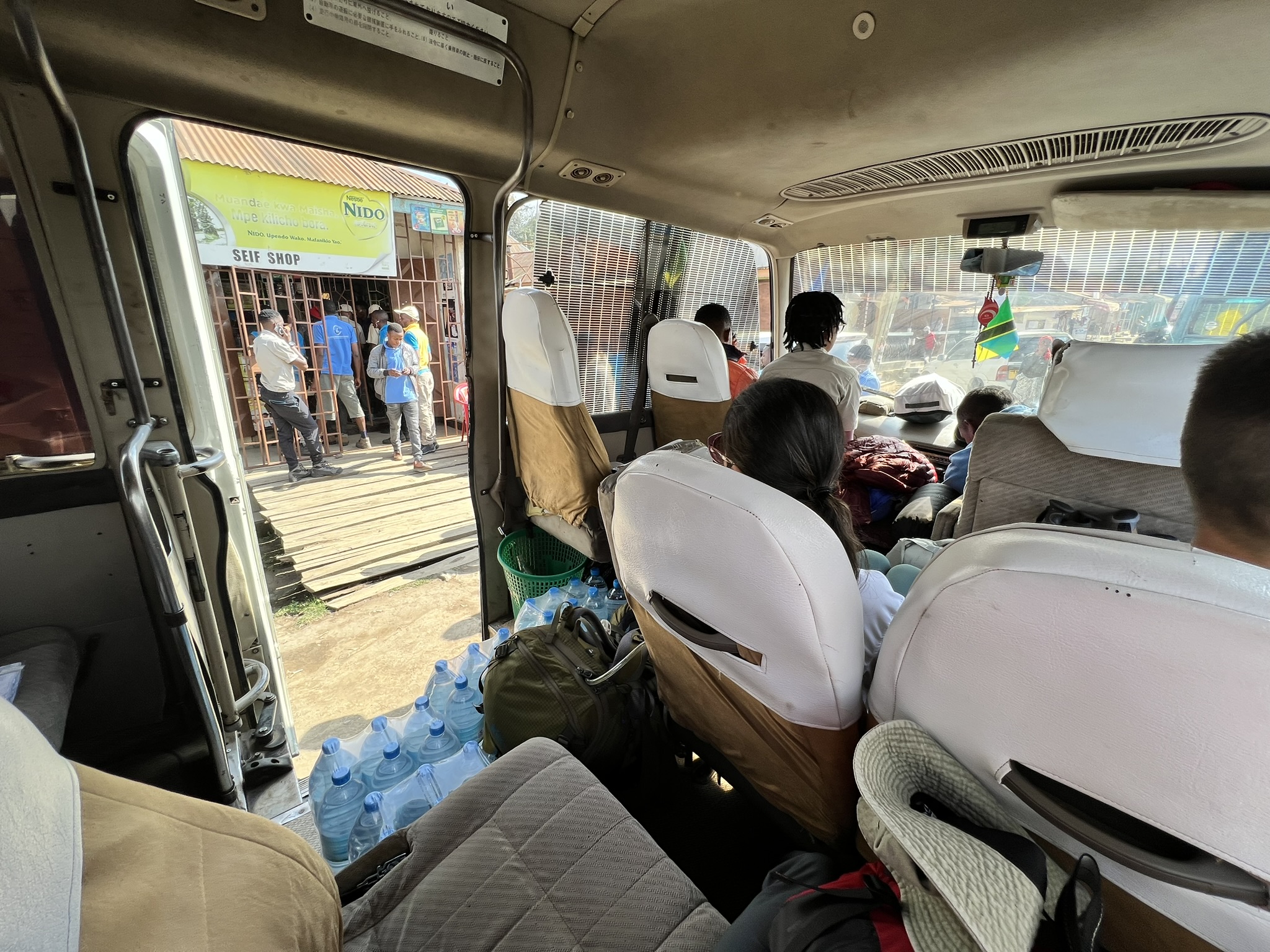
You can’t really tell from this photo, but this not-very-large bus crammed in 30+ people. I was so impressed by the human tetris. Nothing like a good ol’ shoulder-to-shoulder action to break the ice for a group that would not see a shower/bath for the next 7 days.
We embarked on the Lemosho route to the summit of Kilimanjaro. Out of the seven possible routes, Lemosho is one of the routes with the highest summit success rates, particularly because elevation gain is gradual, and there are times when you climb to higher elevations during the day, but then sleep at a lower elevation (to allow your body to better adjust to the altitude). Here I am at the Lemosho entrance gate. This is the cleanest you’ll ever see me in this blog post.

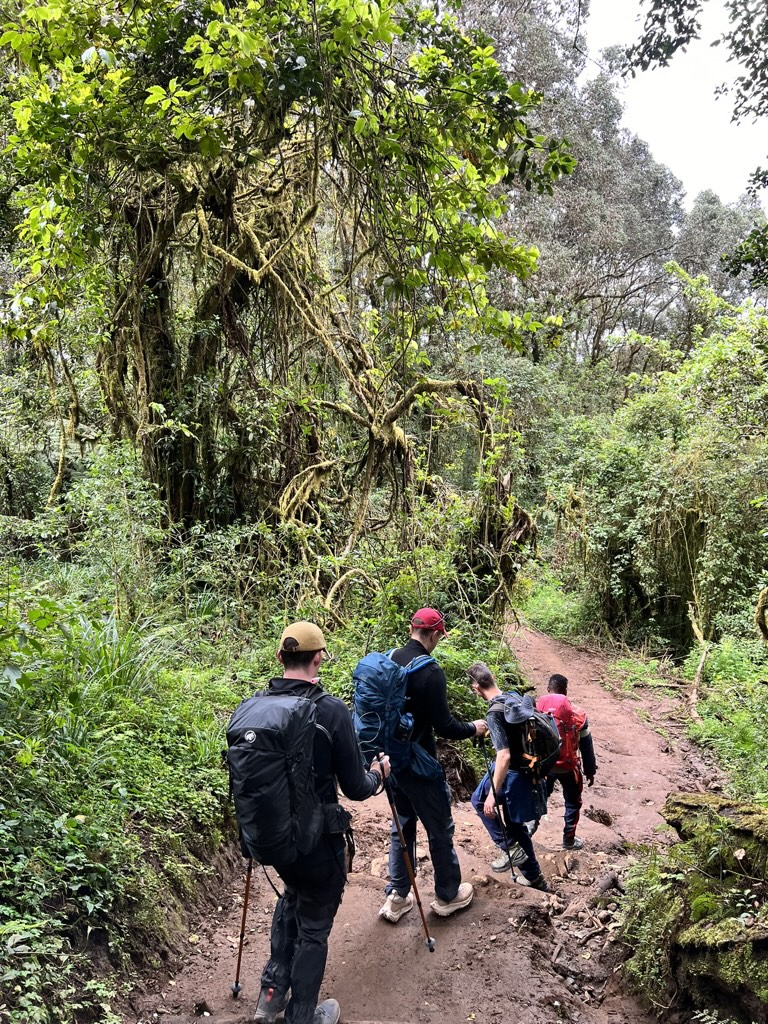
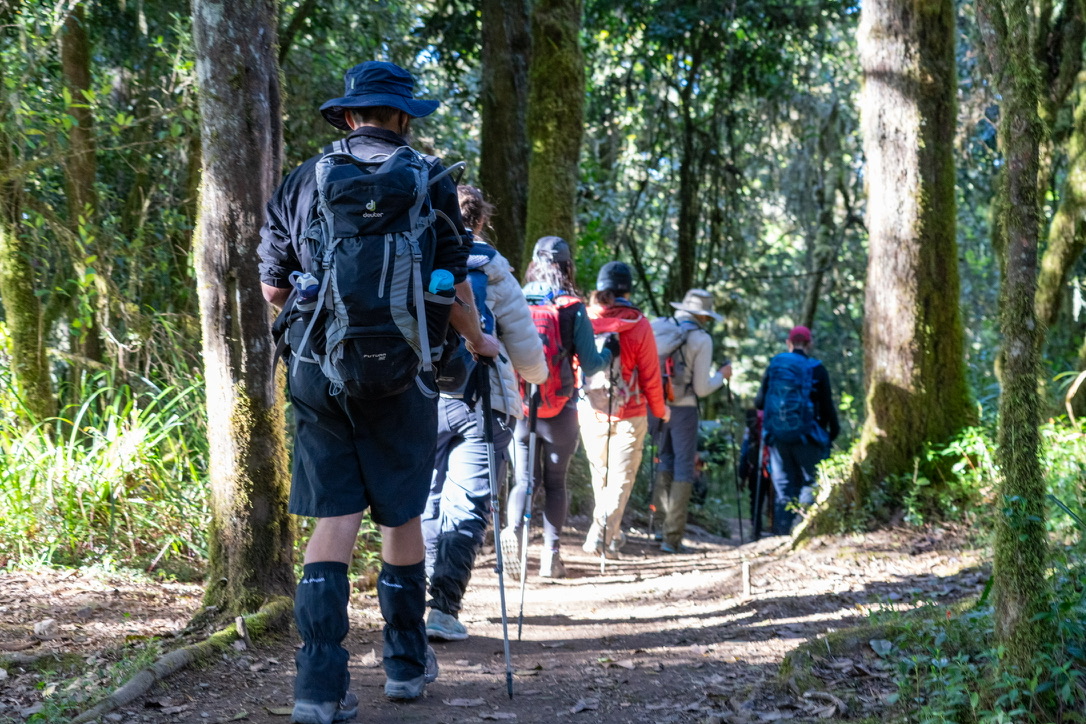
The jungle was lush and green, and the trip probably started out at a balmy 65-70 degrees F, but slowly descended in temperature as we climbed up. One of the first things I noticed as we were hiking was how damn SLOWLY we were going. “Pole pole” (“poh-lay poh-lay”) is a Swahili phrase frequented during the Kilimanjaro hike that means “slowly slowly”. This refers to how we would be hiking up in altitude for the next week. The guide that was leading the pack for the day (each day they swapped out for a new guide) would set the pace for the entire group, and the intention was to make sure that we allowed our bodies to gradually acclimatize.
What a contrast “pole pole” was to my experience hiking the Inca trail last year, when we literally sprinted to the Sun Gate/Machu Picchu on the last day…
(Some of the photos – basically all the nice ones – you’ll see in this post were expertly captured by Jason, a fellow trekker from Phoenix, who brought his DSLR and documented the trip in such a gorgeous way. Thank you for these photos, Jason!!!!)
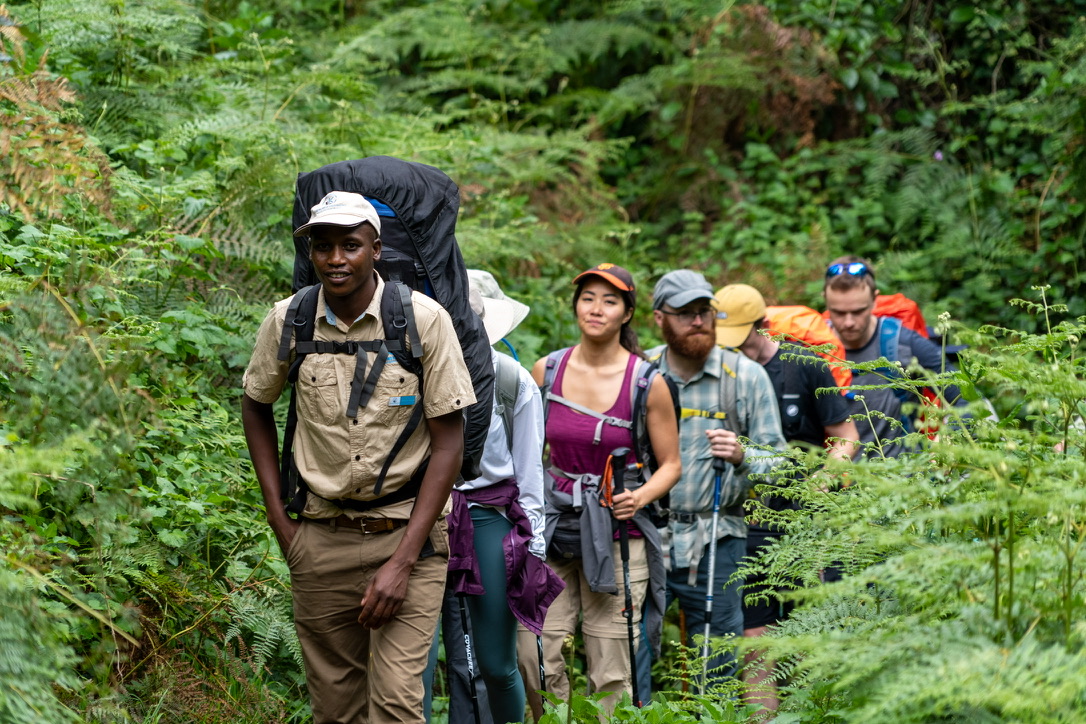
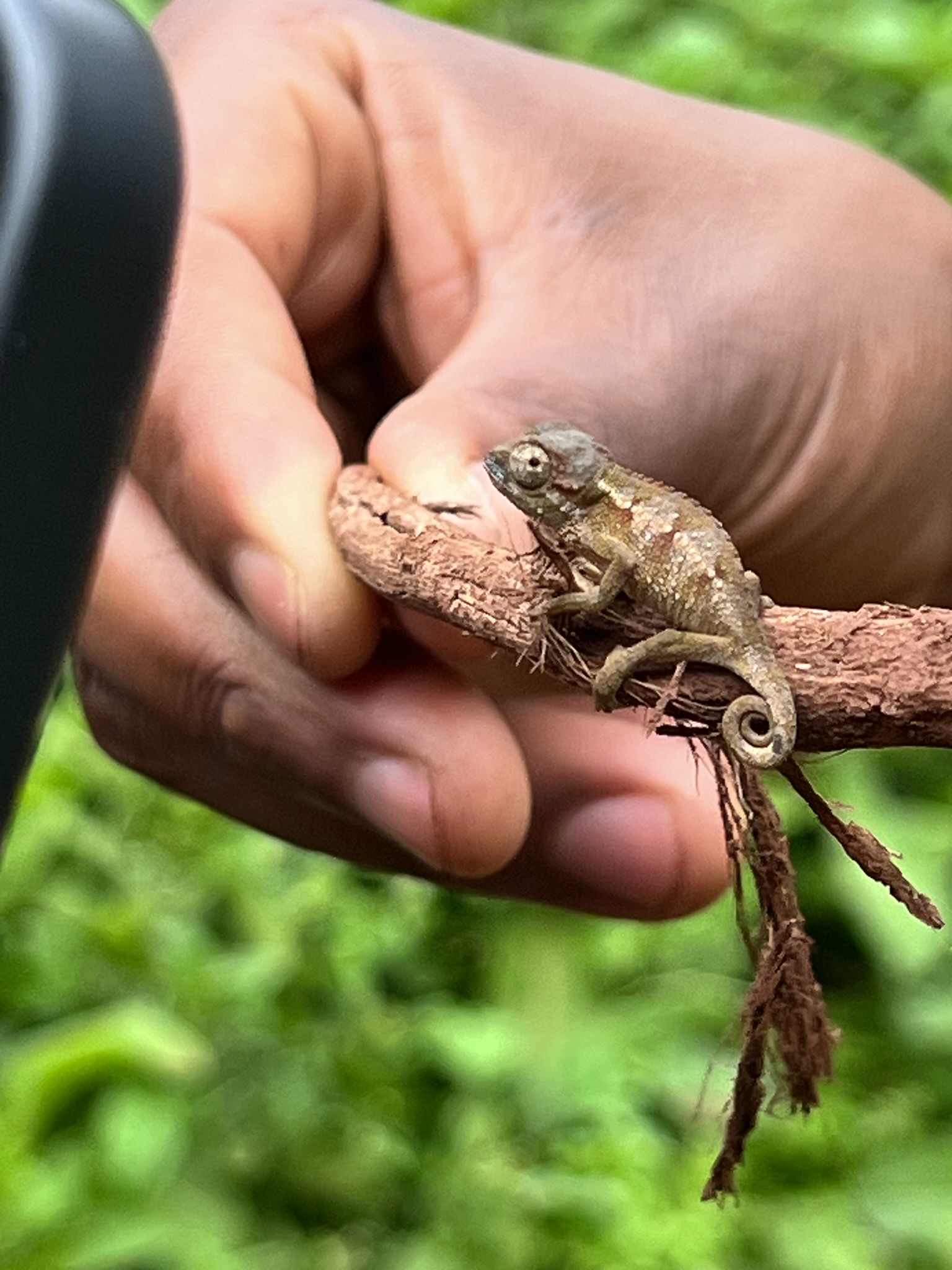
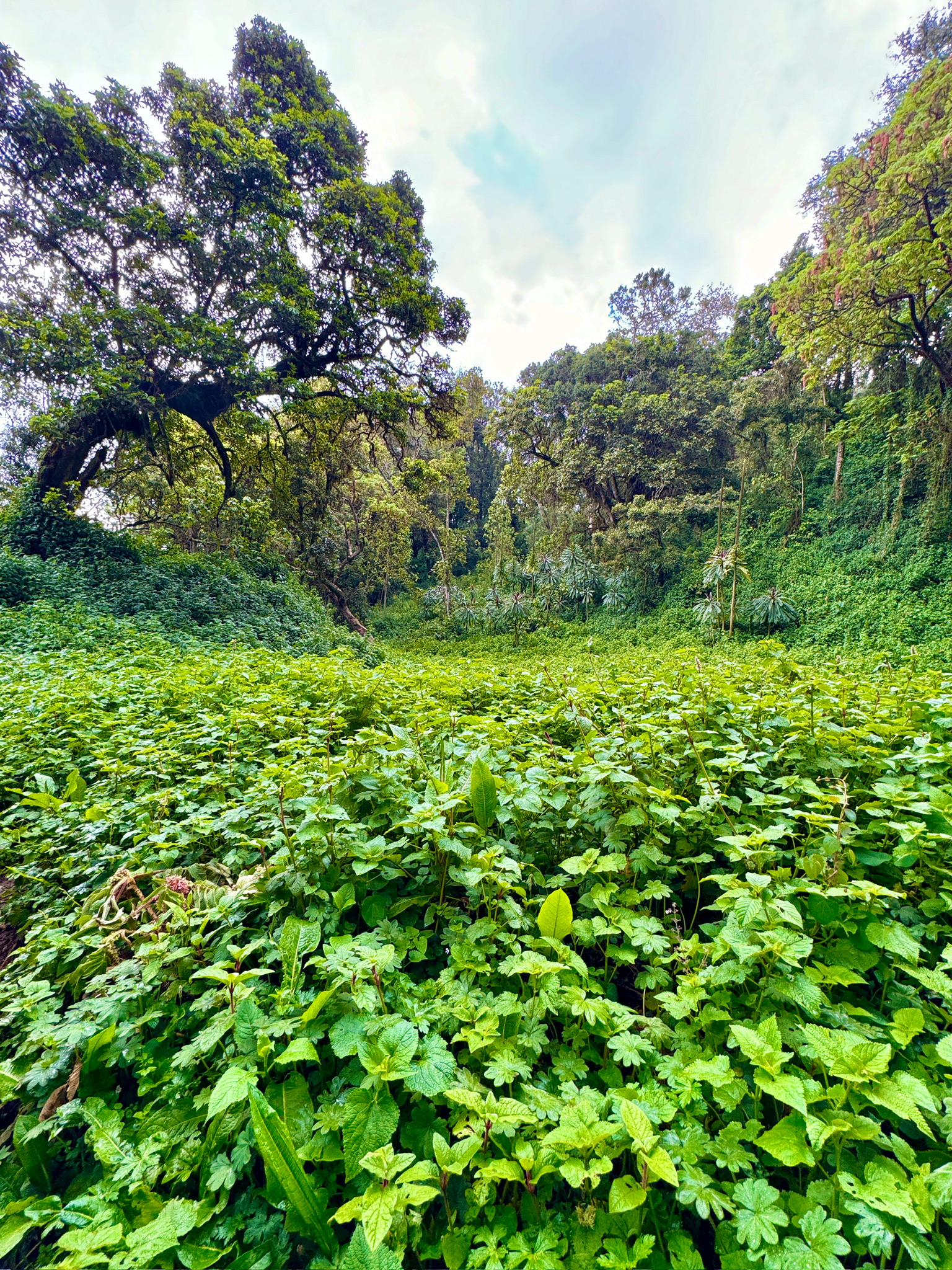

In pockets along the course of Day 1 it started to sprinkle, then to rain, then thunder, and more rain. We had to don our waterproof clothing and strap on our backpack covers. I thought to myself “oh boy, here we go – 7 days of start, stop rain…”. (Spoiler alert: I was wrong, no rain while hiking after day 1.) What an absolute treat to see a ton of Colobus and Blue Monkeys along the way (apparently Blue monkeys are named as such because they have blue balls??? nice). We also saw this cute lil chameleon. So smol!!!!!
The first day of a trek is always slightly unnerving because you never know how a group of strangers is going to mesh – especially if we were going to be stuck together for an entire week. I really lucked out – everyone in our group (including guides and porters) were inviting, optimistic, encouraging, and shared such diverse perspective and background. Conversation was free-flowing and lively (as it would be for the rest of the trek). Incredibly grateful to get to know this wonderful group of people.
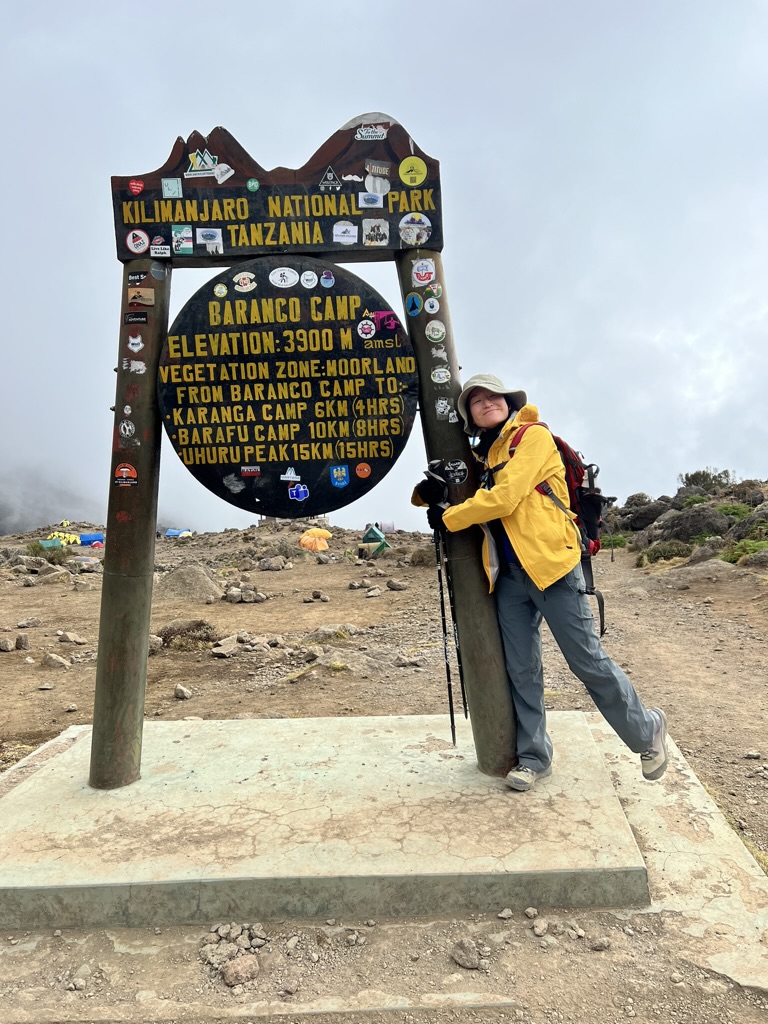
You’ll start getting sick of seeing me in front of these camp signs everyday, but here is camp for night one: “Mti Mkubwa Camp”.
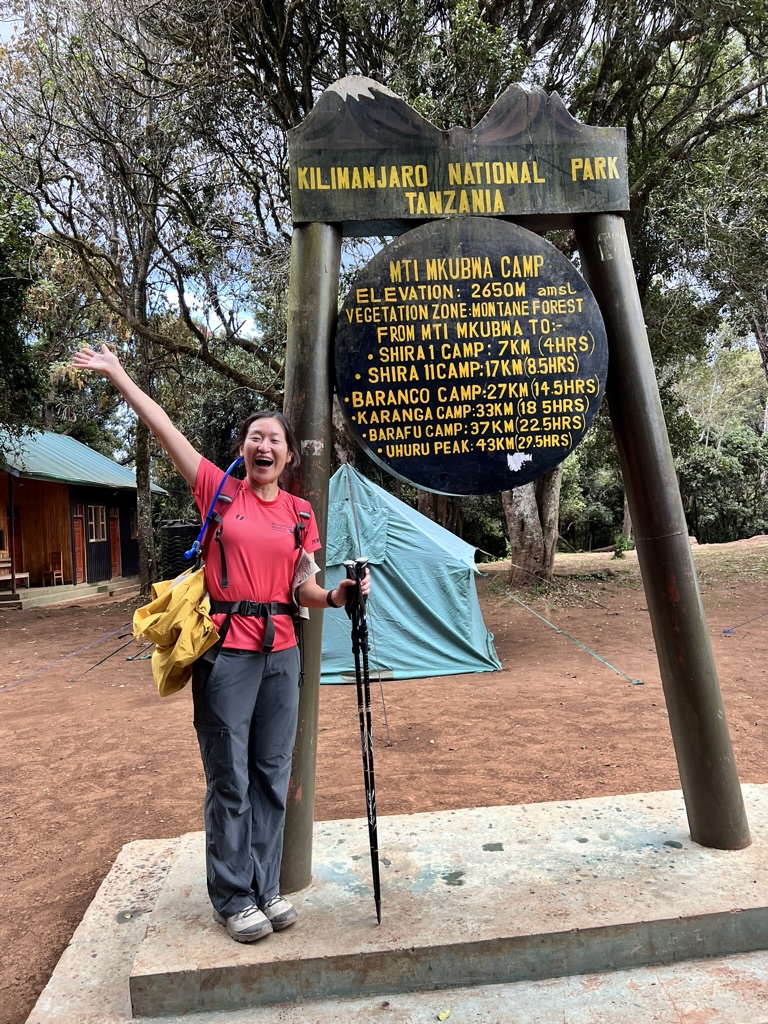
This camp still located in the jungle, and at an elevation where mosquitos (unfortunately) still live. Only got stung once, but not thrilled that I had stopped malaria pills because the lead guide said to prioritize altitude sickness pills…
Speaking of pills, all trekkers were poppin pills everyday like we were at EDC (untz untz untz), taking all kinds of things, including Diamox – altitude sickness pills – for better acclimation. There are a few side effects of Diamox like nausea (which I started to feel that day), but another one of the unfortunate side effects is peeing a lot. I felt that, too. A lot. To the point where I was looking at the water I had drank for the day which was “not a lot” and wondering where any of this liquid was even coming from…………..
At our daily briefing that night, our lead guide guilt-tripped all of us into revealing how much water we drank that day. Guidance was 2-3 liters. I admitted I drank not even 1L. Probably one of the first times I’ve failed a test. Didn’t feel good, man.
He said that on Kilimanjaro it’s often not an impulse to drink water because it gets very cold and your body just doesn’t yearn for water like it would if you were actively sweating. So we have to remember to drink water throughout the day, as the oxygen in the water molecules also helps with better acclimation to the elevation.
Part of the daily routine was a twice-a-day oximeter and heart rate exam to make sure we were all healthy and able to proceed on the trek. Why I was nervous taking my oxygen/heart rate readings everyday? School/Exam trauma from over a decade ago holding strong, ladies and gentlemen.
That night, as with most nights thereafter, we went to sleep around 8PM. I’ve never been the best sleeper outdoors, but shoutout to my dope earplugs that did their thang (most of the time). The one time they did not work was only the first night when around 10:30PM my tent neighbor SCREAMED BLOODY MURDER: “WHAT THE FUCKKKKKK? WHAT THE HELL ARE YOU DOING?” which woke up the entire camp. Thinking she was in trouble, I immediately yelled “Hey, what’s going on?! Are you okay?!” She responded, “Nothing. Yeah.” I laid there, wide-eyed, contemplating if I should do anything. After hearing no more sounds or movement coming from her tent (after all, tents have zero sound insulation), I figured she was okay and eventually, in utter exhaustion, fell back asleep.
We all discussed it at breakfast the next morning and she had no idea. “What, really? All my dreams last night were actually really pleasant.”
Day 2 Destination: Shira 2 camp (Elevation: 3850m)
Day 2’s hike was a pretty long as we went up and down in altitude through several ridges – a 9 hour affair. While the hike was not too challenging, I did I start to get inexplicably sleepy midday. Literally feeling like I could fall asleep walking. The only thing that got me out of this funk was some Nerds Gummy Clusters a trekker shared with me (like excuse me??? a candy has no business being THAT GOOD.)
Knowing the length of the day/hike would be challenging – and we would be tired and cranky – the assistant guides kept trying to keep us engaged by doing chants and rapping/singing/dancing when we took breaks.
Examples:
- One of the guides Salim chanted “follow the leader leader leader follow the leader…” and we would all scream “WHOOOOOO!!!!” – repeat 1,000 more times
- Chant: “CK!” “Oy Oy!” “Oy Oy!” “CK!” “One Team!” “One Dream!” “One Dream!” “One Team!” “Nonstop!” “To the Top!” “To the Top!” “Nonstop!” “More Fire!” “More Water!” “More Water!” “More Fire!”
One of the trekkers who was very into these chants said, exasperated: “my god… it’s like I have Stockholm syndrome………”
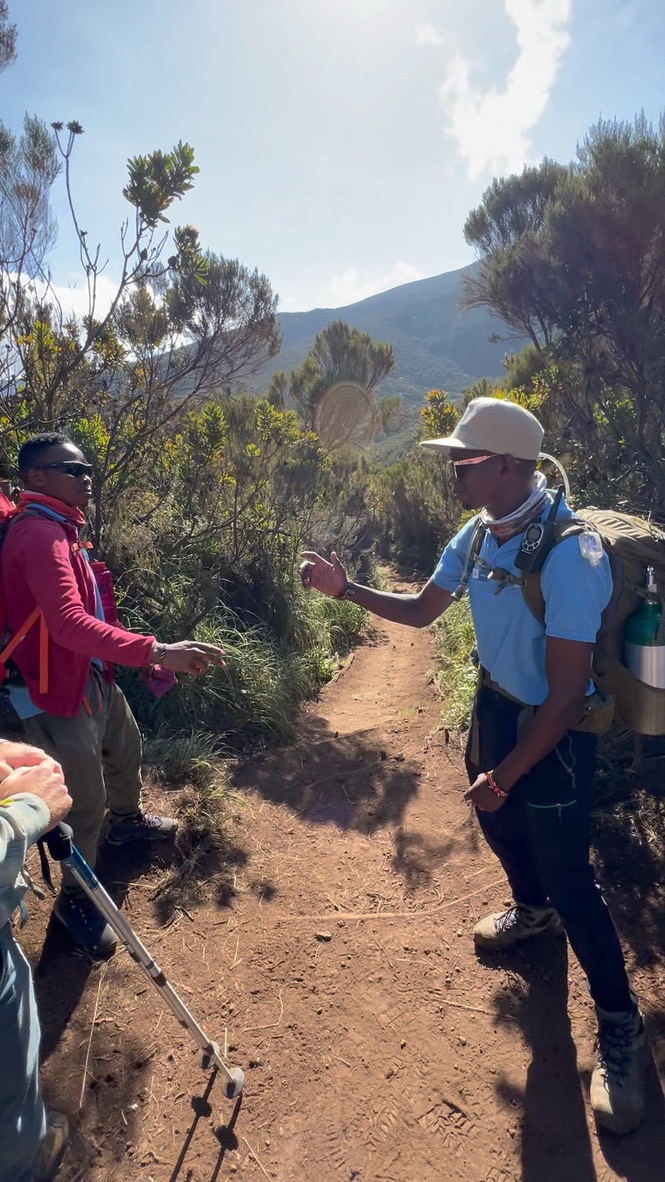
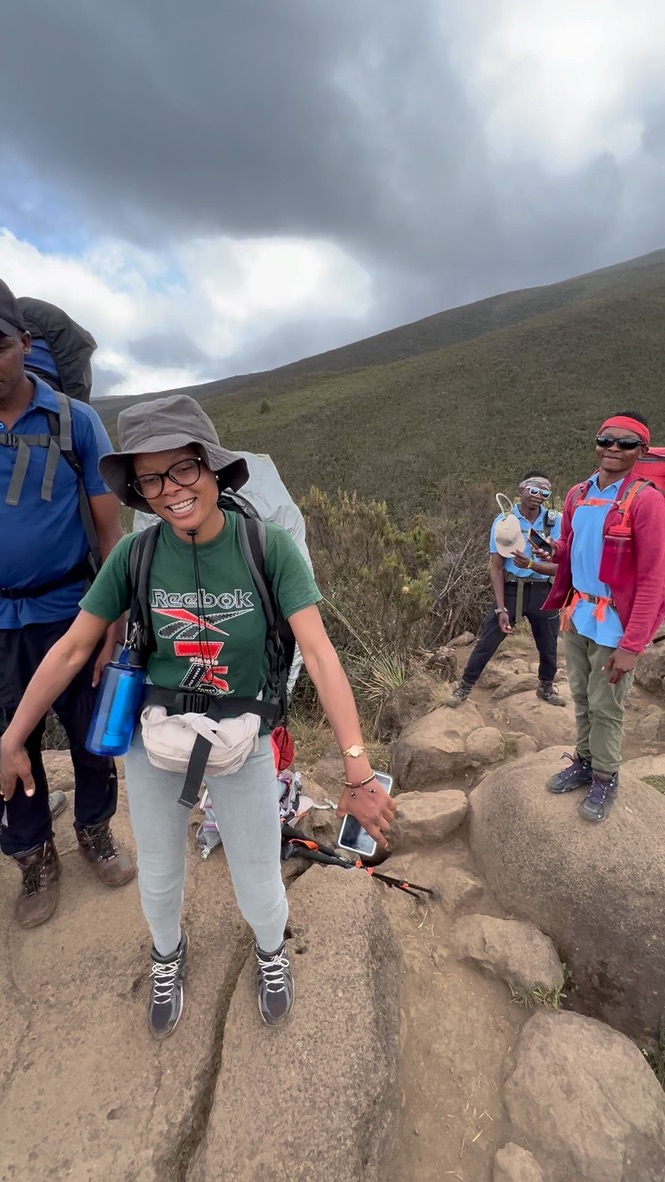
We took a pit stop at Shira 1 camp and, after a long day, reached camp for the night called Shira 2.
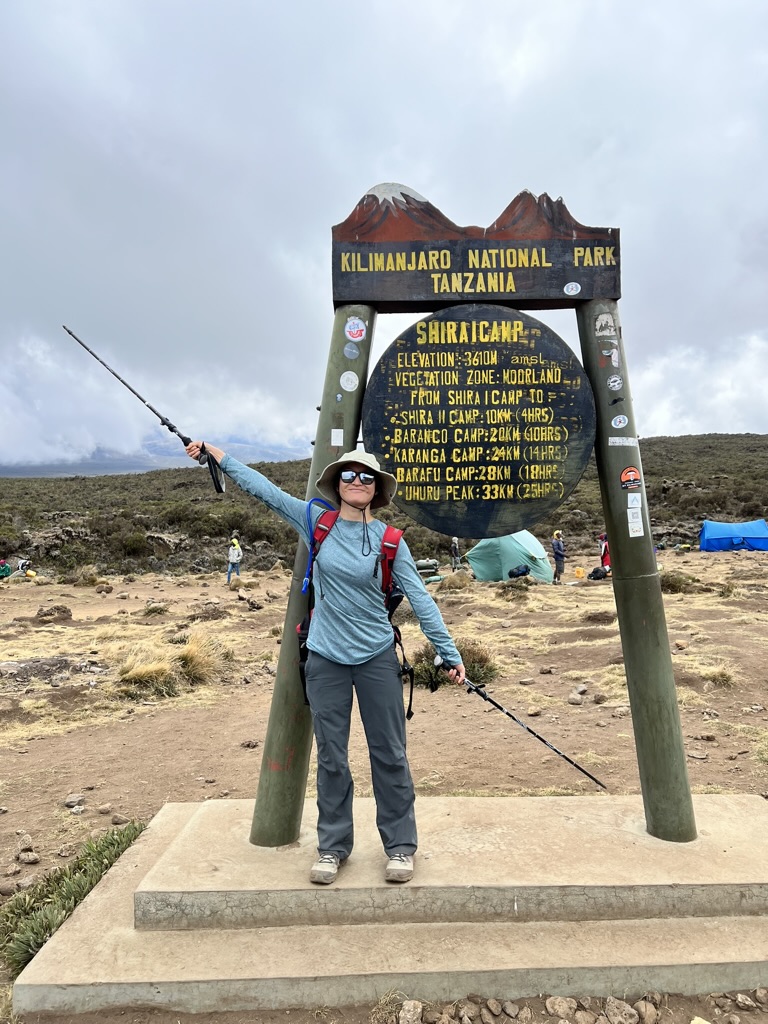

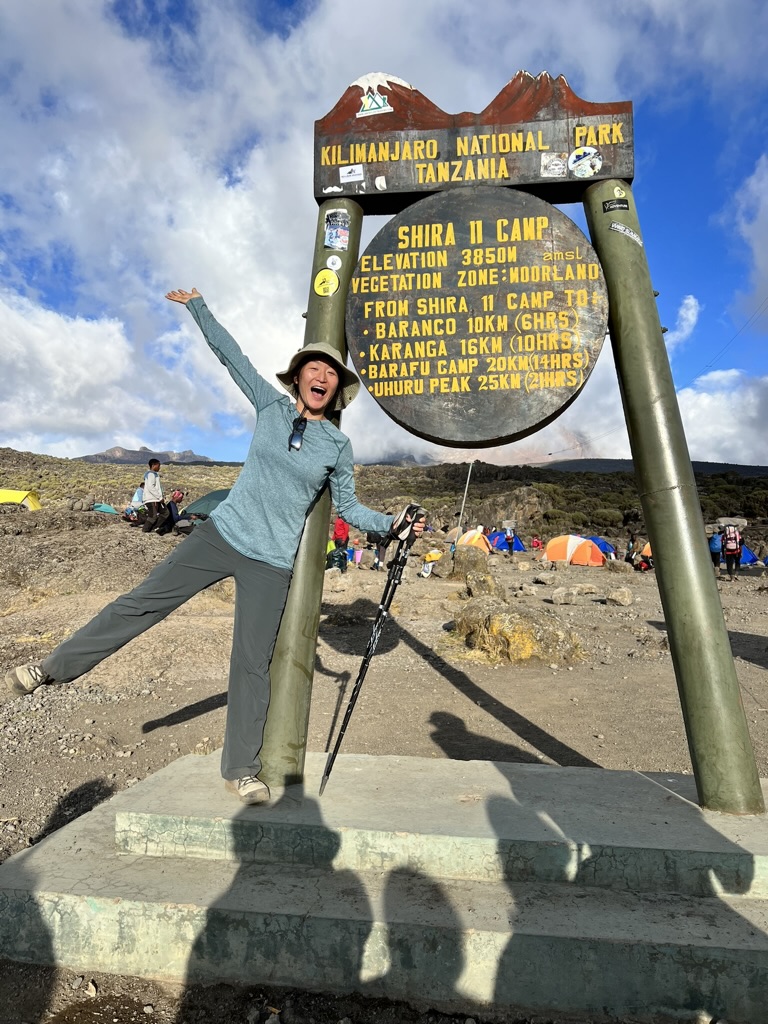
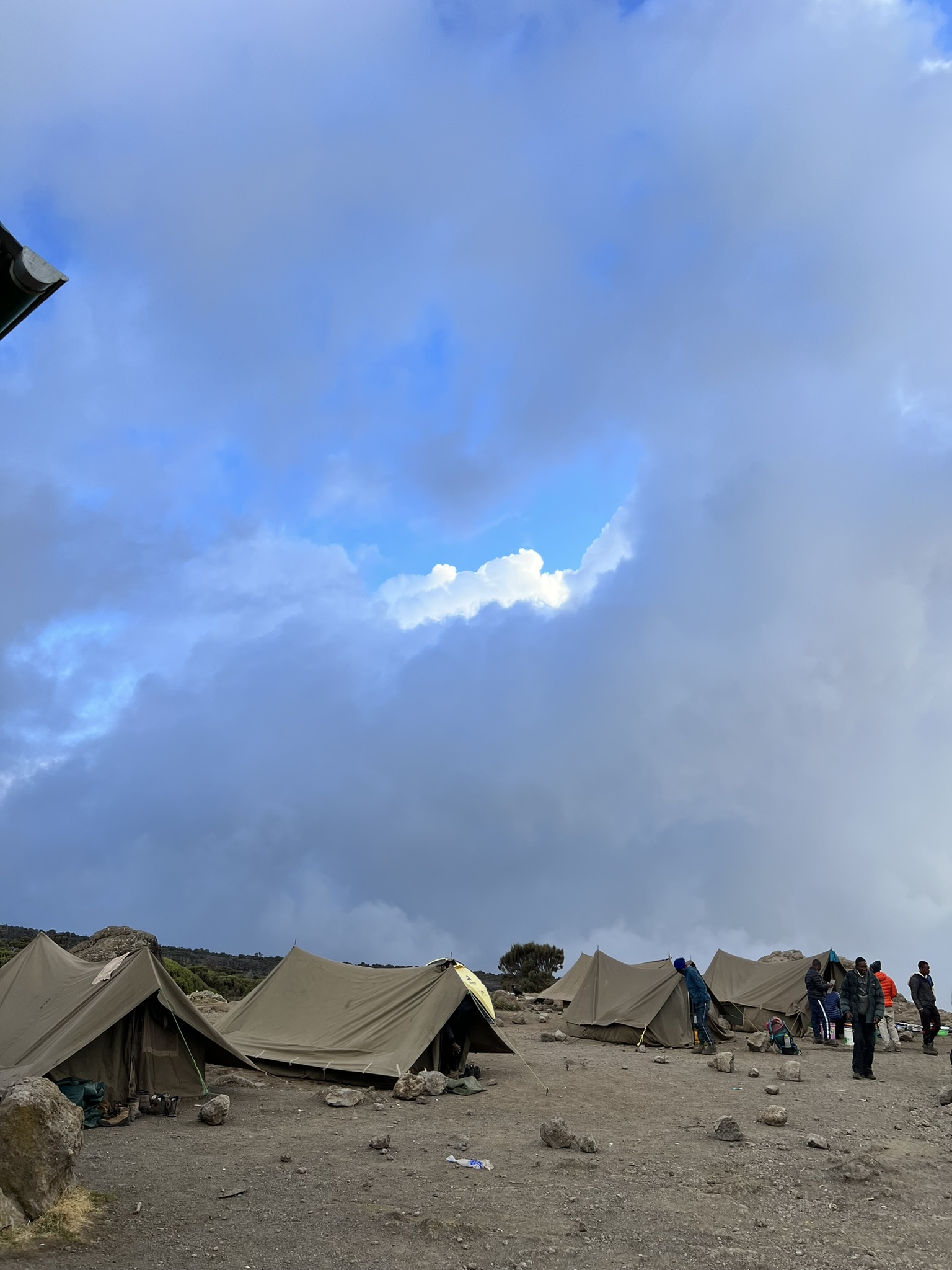
Side appreciation-note for our porters: The way each day worked was that in the morning, we the trekkers would pack up our duffels + day packs, eat breakfast, and then depart camp. The porters/help staff would then pack up our tents/camp and then BEAST UP THE MOUNTAIN (pass us along the way, not breaking a sweat) to find a location and set up camp for the night. Once they were done setting up, porters would backtrack on the trail to meet us, take our daypacks and offer to clean our shoes and pants from all the dust once we reached camp. To be very honest, the first time my porter Mohammed came and tried to take my pack – I was so prideful (hell no would strong, independent Mendi let someone carry her stuff on a trek). Let me just say, Day 3 onwards I left my pride at the door and accepted and expressed immense gratitude for his help. (Something I have been working with my therapist on so yay progress.) Mohammed was the best.
That night at dinner, the chef and guides presented our fellow trekker Asli with a BIRTHDAY CAKE! What a special treat to be able to celebrate a milestone birthday with her in the mountains~
What’s not a treat: my germaphobia at full blast.
I blew my nose that night in my tent. Because we had exited “jungle zone”, we were now in “dry, dusty territory”. My snot was pure black. Unclear if it was dirt or blood (since it was so dry). Likely both. I used wet wipes to wipe my face and neck at the end of the day. It was like I had caked on a full face of makeup/foundation that day. Despite getting a basin of hot water each night/morning to “washy washy” in our tents, that wasn’t enough.
I remember thinking in my sleeping bag that night (the coldest night of the trek): “It’s not the physical nature of the hike that’s going to be the end of me, it’s the cold and the dirt.”
Day 3 Destination: Up to Lava Towers (Elevation: 4600m), down to Barranco Camp (Elevation: 3900m)
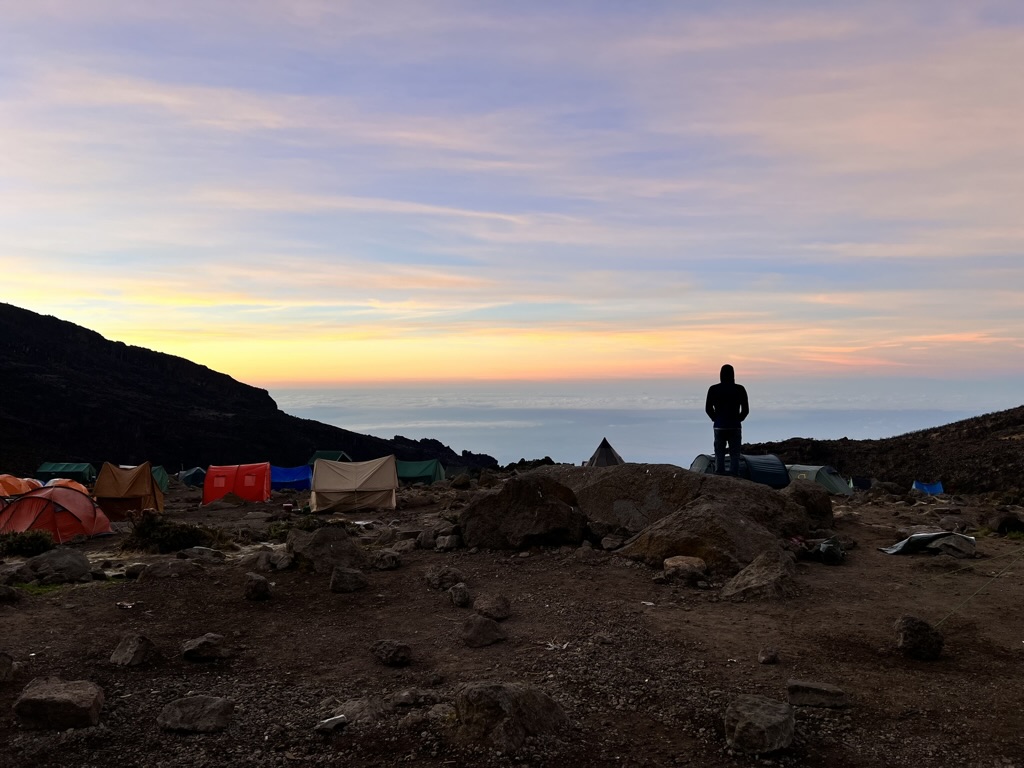
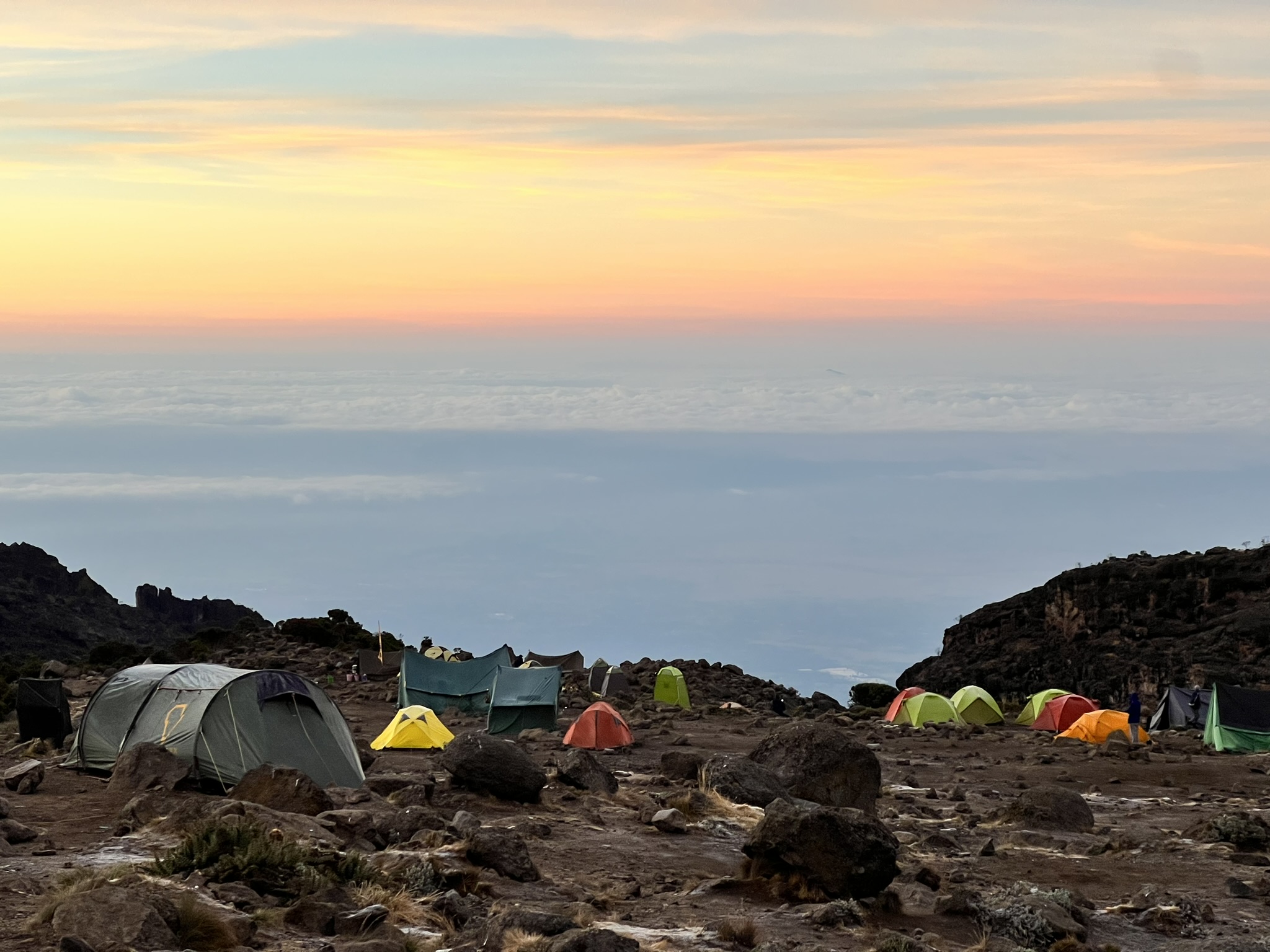
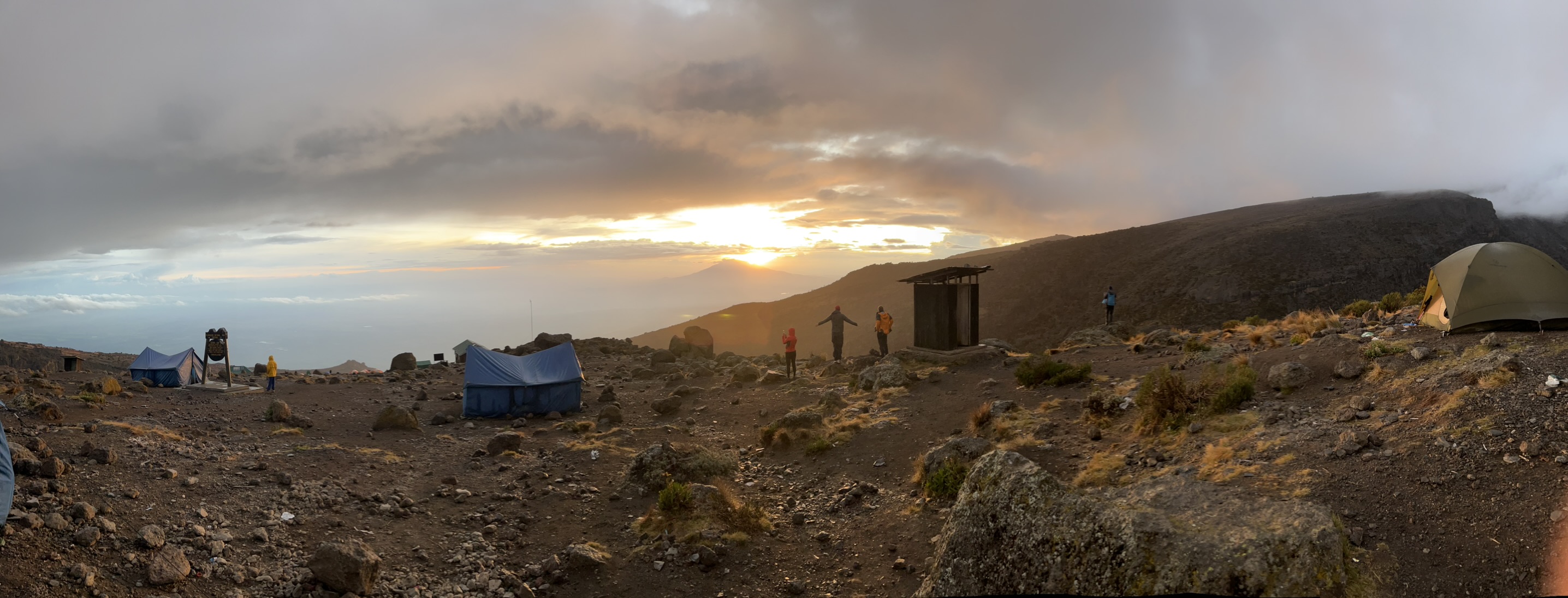
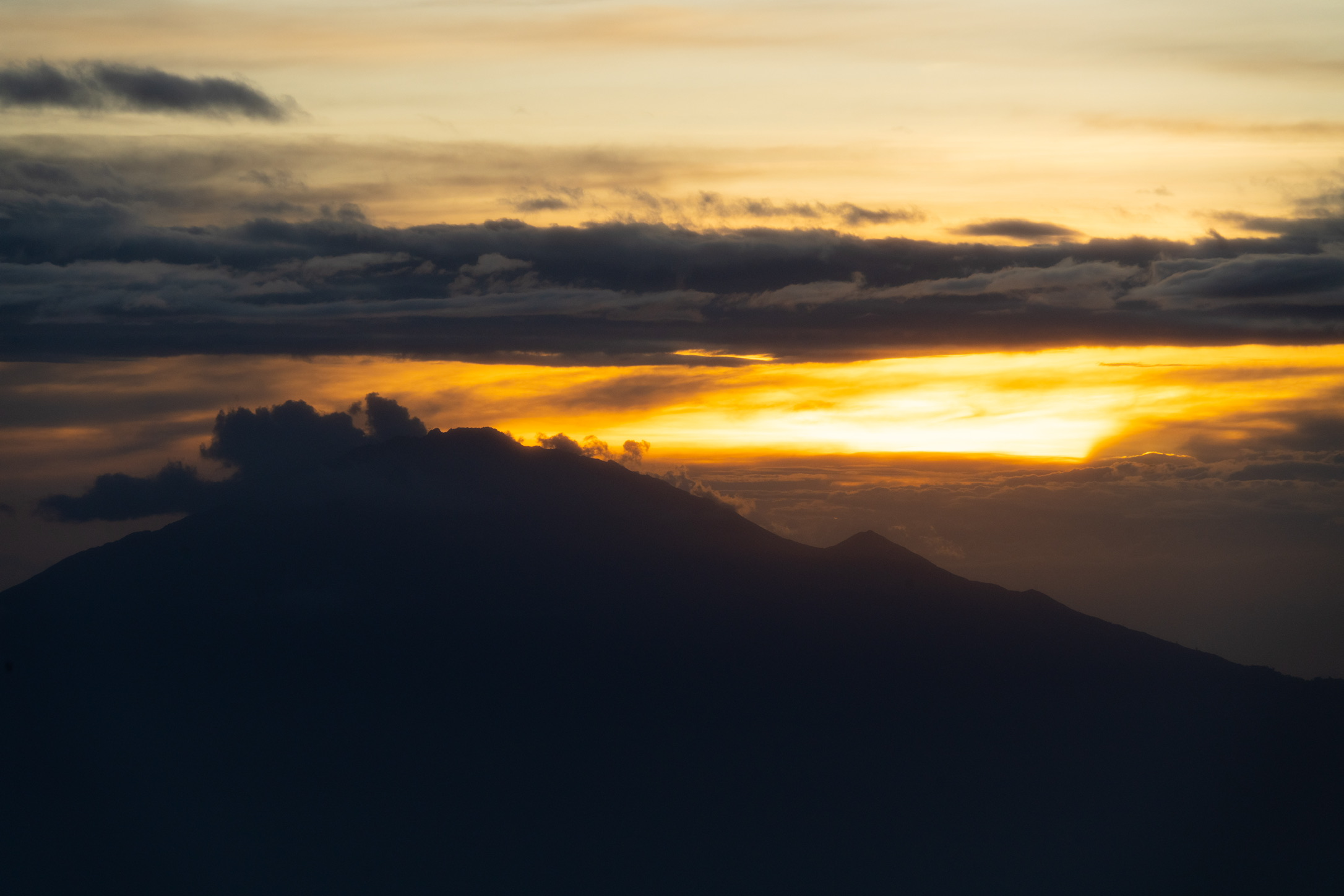
We started off the day with these epic sunrise views. Heaven on earth…….
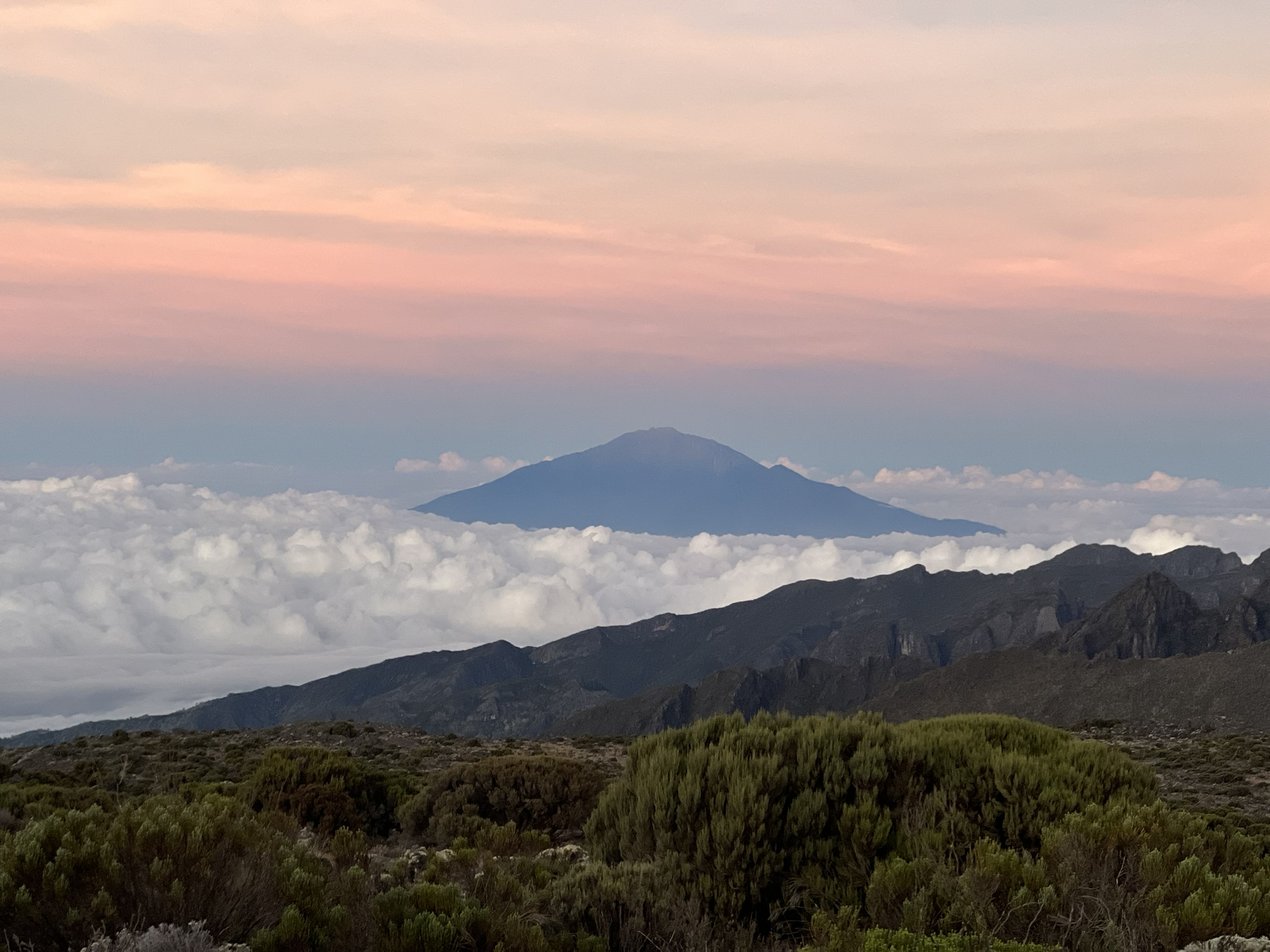
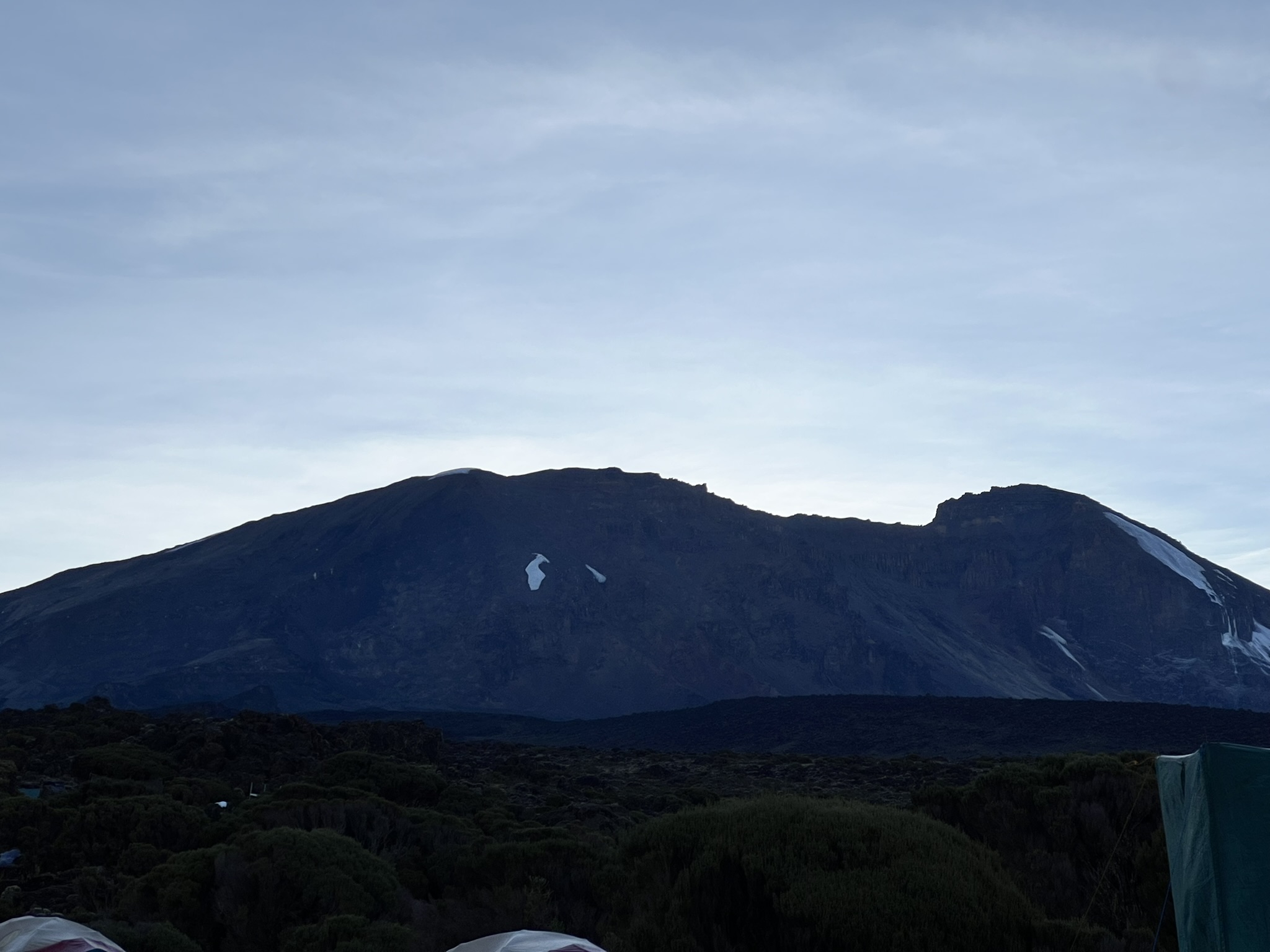
….. No.
Day 3 was hell.
I was plagued with nausea and headaches from the altitude gain.
We ascended rapidly to the Lava Towers at 4600m, then down to Barranco camp at 3900m.
It may look like I’m having a good time in these photos but trust me… I am straight up not havin a good time.
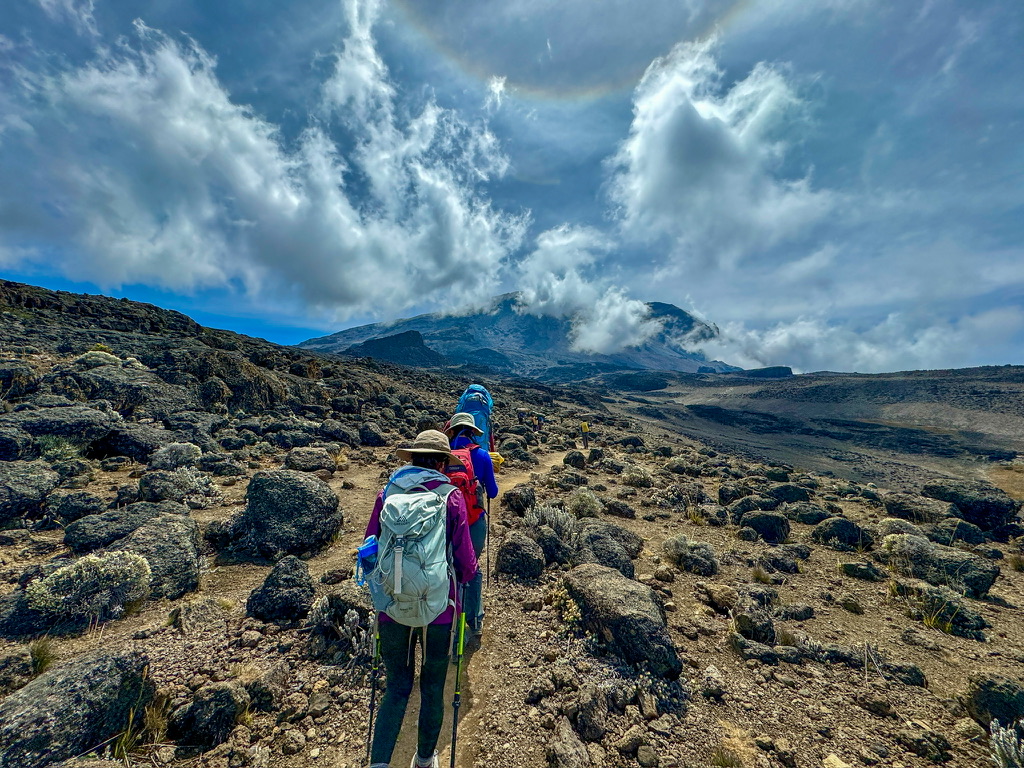
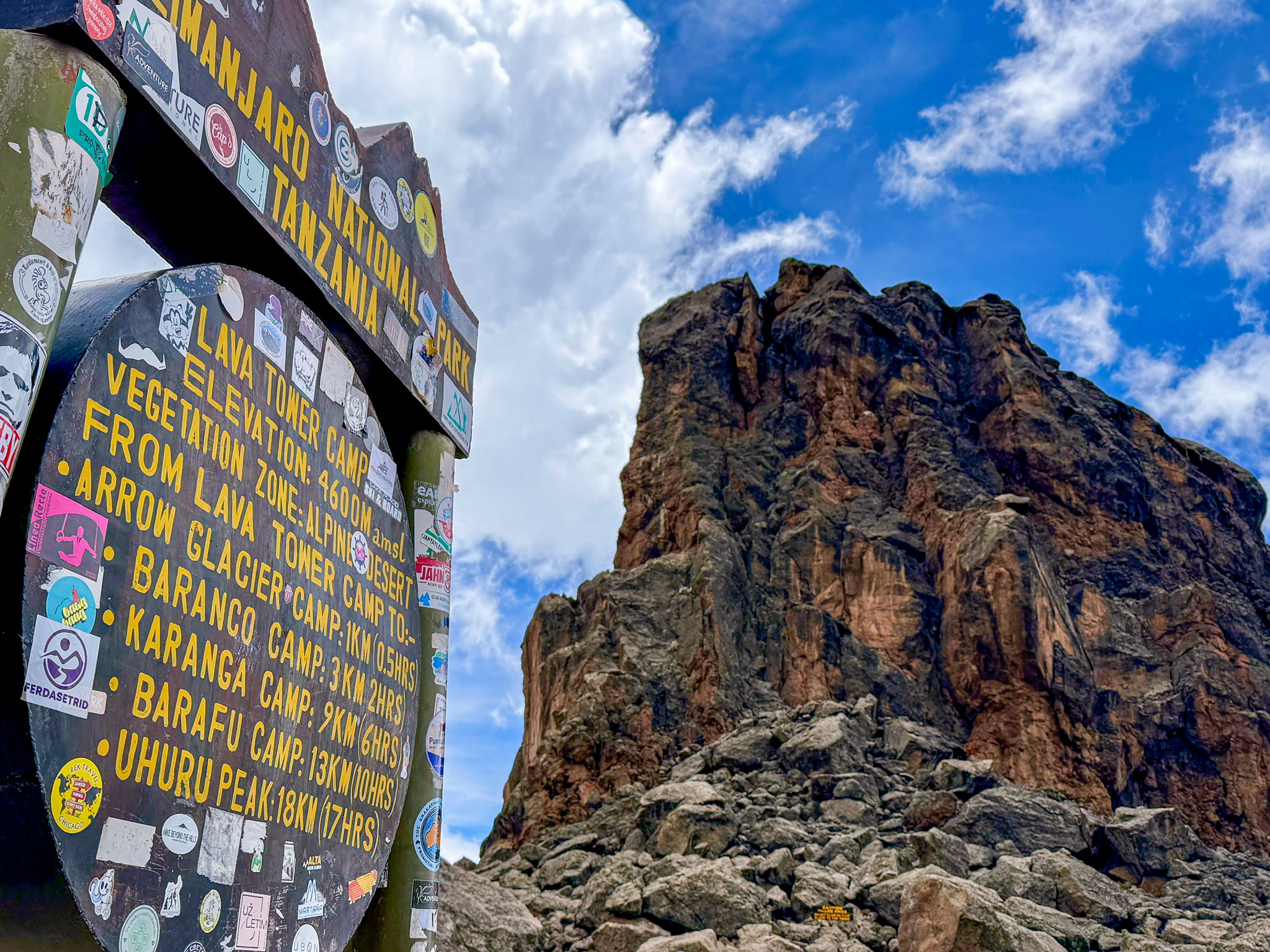
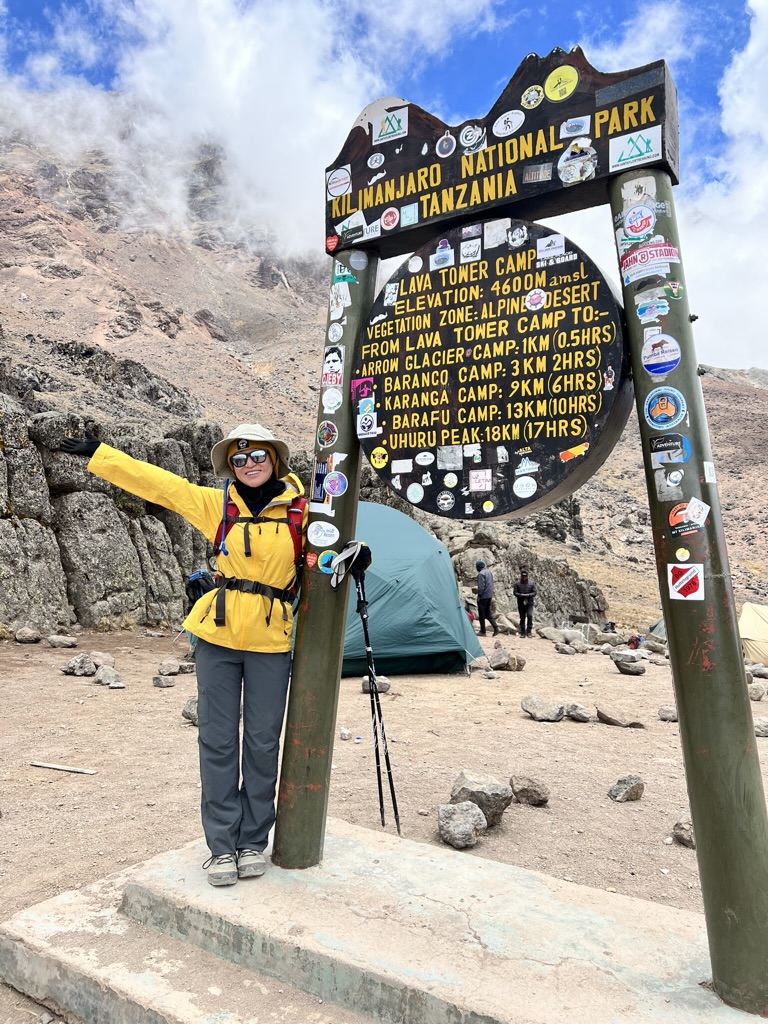
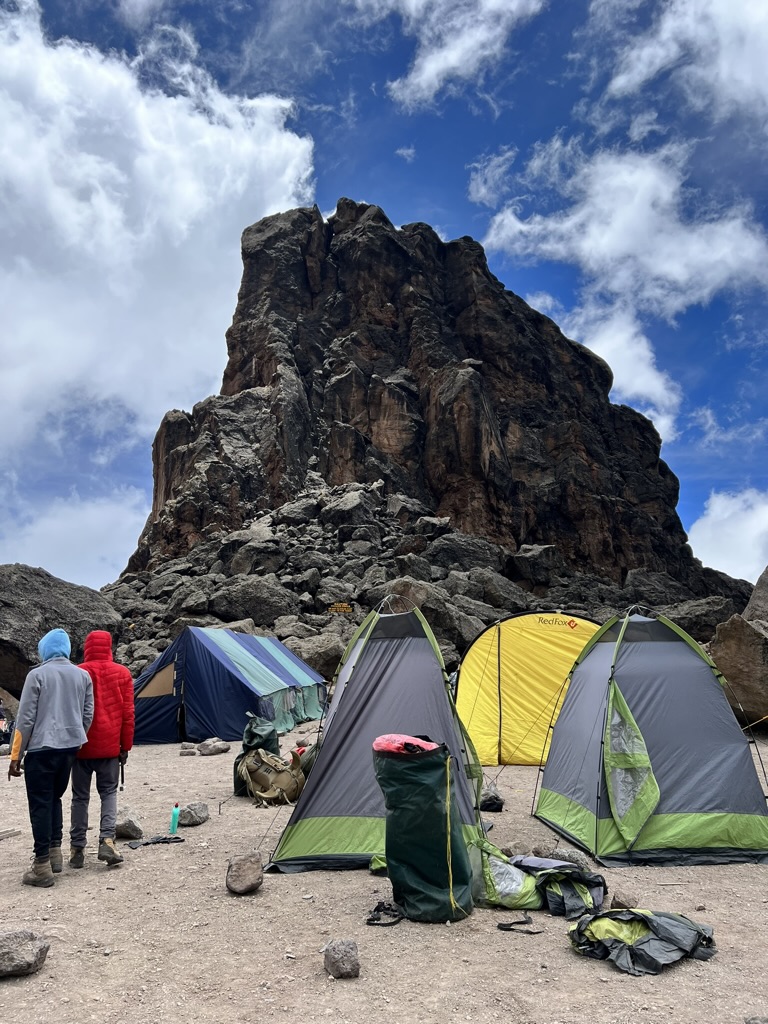
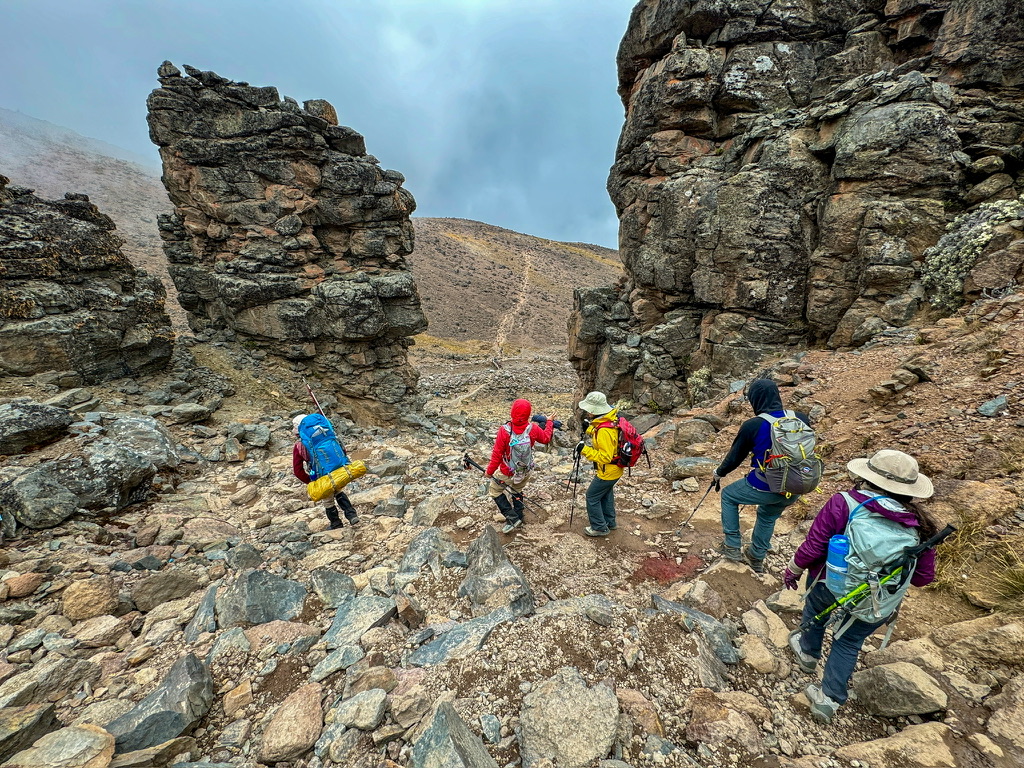
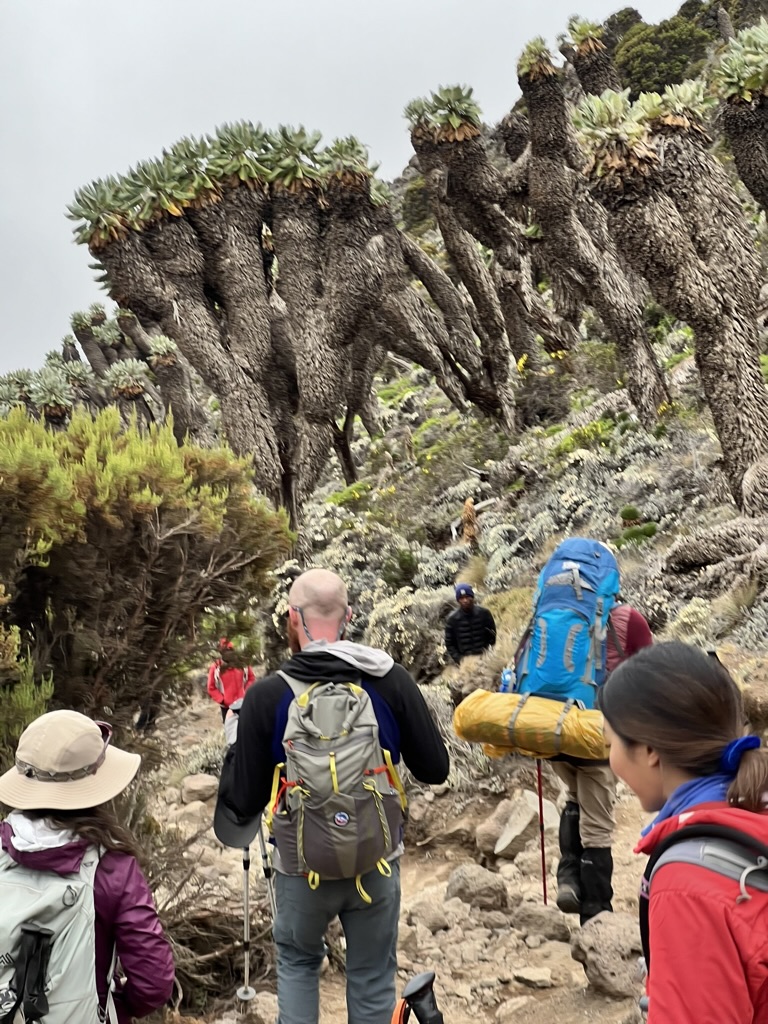

(Btw, those cool looking Dr.-Seuss-esque trees are the Dendrosenecio Kilimanjari, which only grow on Mount Kilimanjaro between the altitude of 2500 – 3000m.)
I distinctly remember the below moment as I drank some mango juice (and later some hot ginger tea) at the top of Lava Tower. It was SO FREAKING COLD……. and I was SO FREAKING NAUSEOUS.
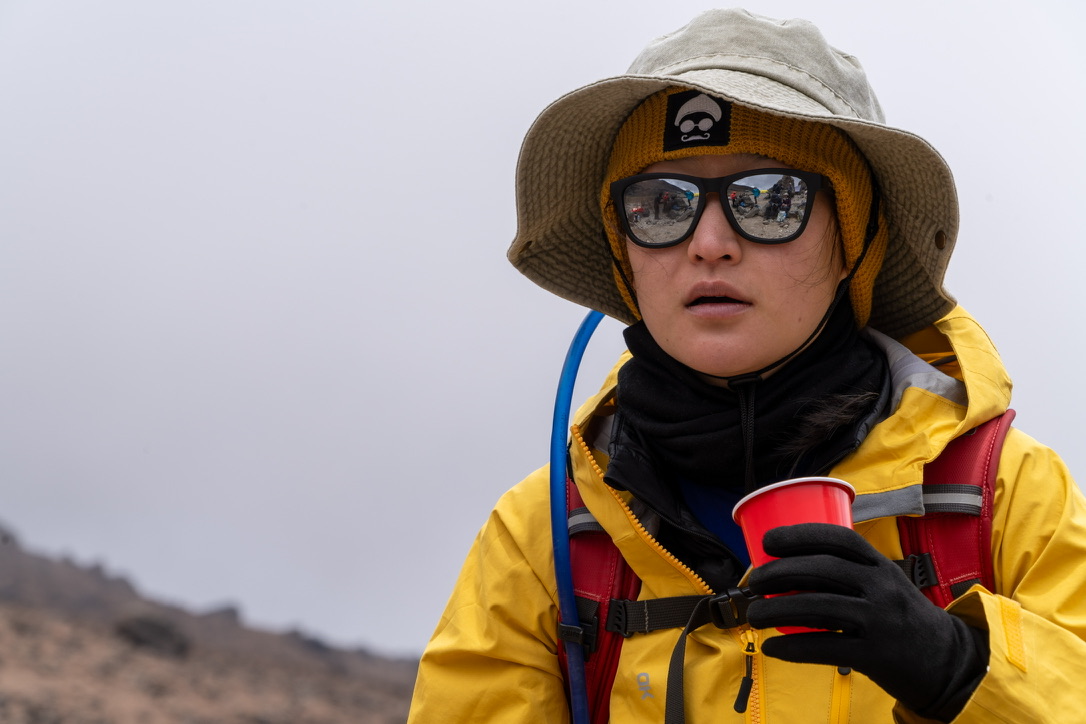
This photo depicts my immense joy reaching Barranco camp for the day:
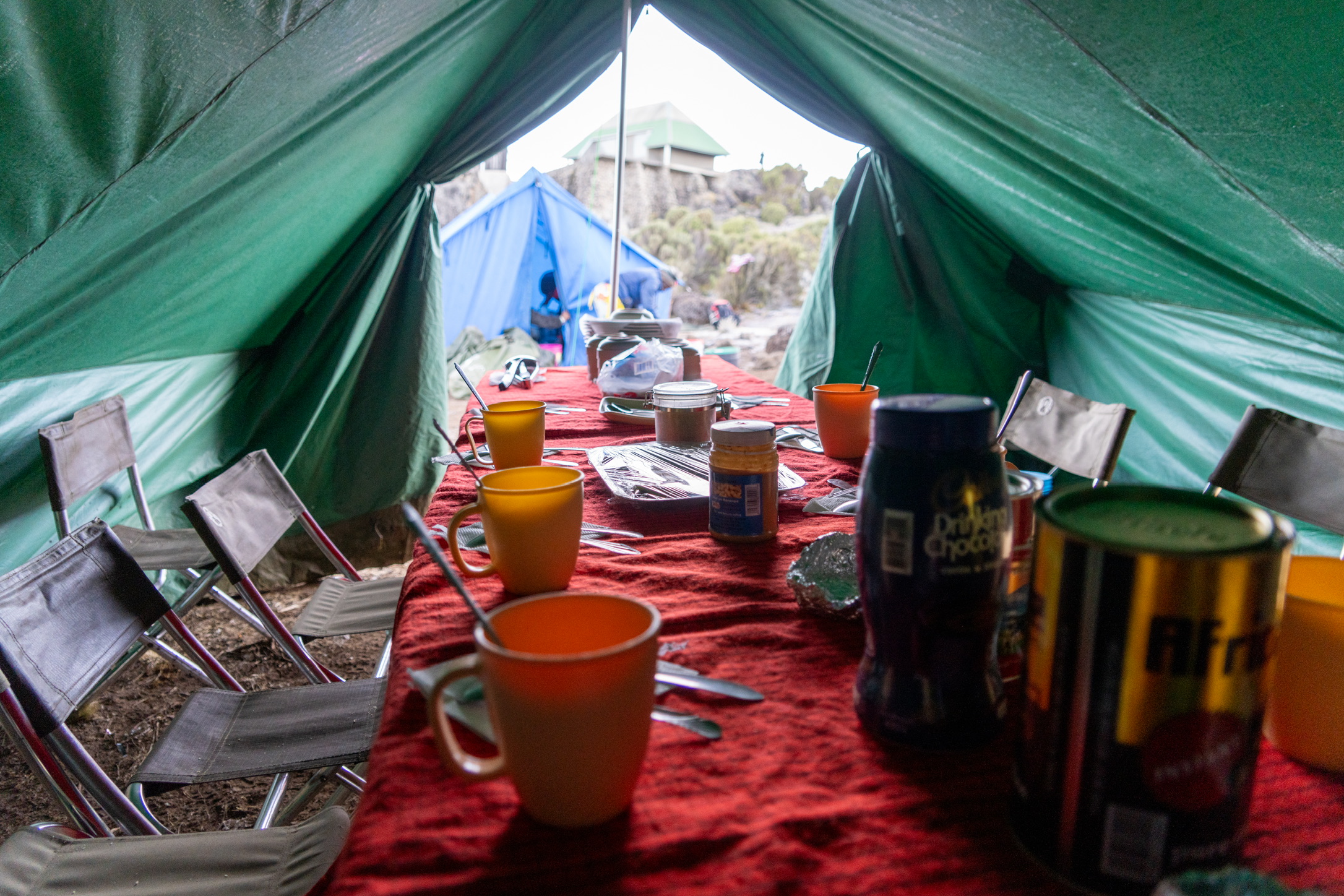
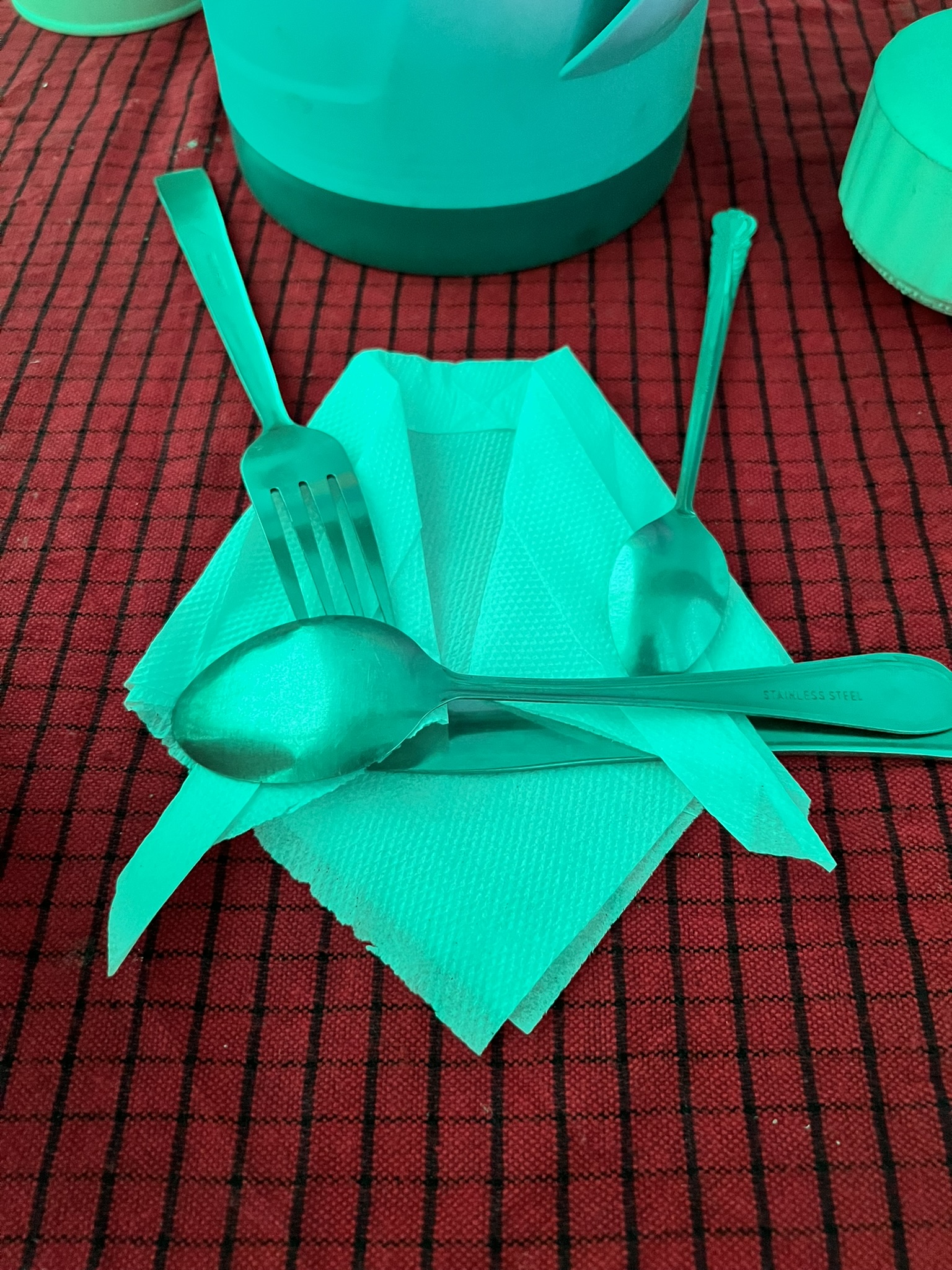
Here’s a photo of our mess tent (where we ate 3 meals a day for 7 days, every single day with different creative napkin/cutlery formation designed by our “waiters”. Jifty and Joel were the cutest/nicest.)
We saw a beautiful sunset that night, and I saw my first ever glimpse of the milky way (but bad pictures because of my iPhone).

By this point in the trip, “washy washy” (the basin of warm water we received each morning/night) was befuddling to me. At the risk of sounding ungrateful, I really had no use for it after day 2. I was definitely not going to use it to wash my body, since (1) I did not fathom shedding any clothes; and (2) the water would just become icy cold seconds after hitting my skin. So, each day after they delivered the bowl to my tent I would just straight up stare at it for like 5 seconds…………… and then use it to brush my teeth (sensitive teeth gang WYA).
I did reflect that night about how much I had learned on this trip about camping:
- First, that wet wipes are a savior. Wet Wipes – pls sponsor me.
- Second, that you can stuff a hot water bottle at the foot of your sleeping bag to keep your feet warm at night. But you need to make sure that the water bottle is single layer and not double insulated so it doesn’t explode in your sleeping bag. Very nice of him, one porter Joel lent me his water bottle so I could be warm at night 🥲
- Third, if your tent is on an incline (which ours were like 4 out of 6 of the nights), stuff a duffel/backpack at your feet so you don’t keep sliding down at night (plus it insulates your feet from the cold of the tent).
- Fourth (I would learn on summit day), at freezing temps you need to empty your camelbak hose after every drink so that it doesn’t freeze and you lose access to your water! Also, that water freezes from the top down, so store your water bottles inverted so that the bottom freezes first.
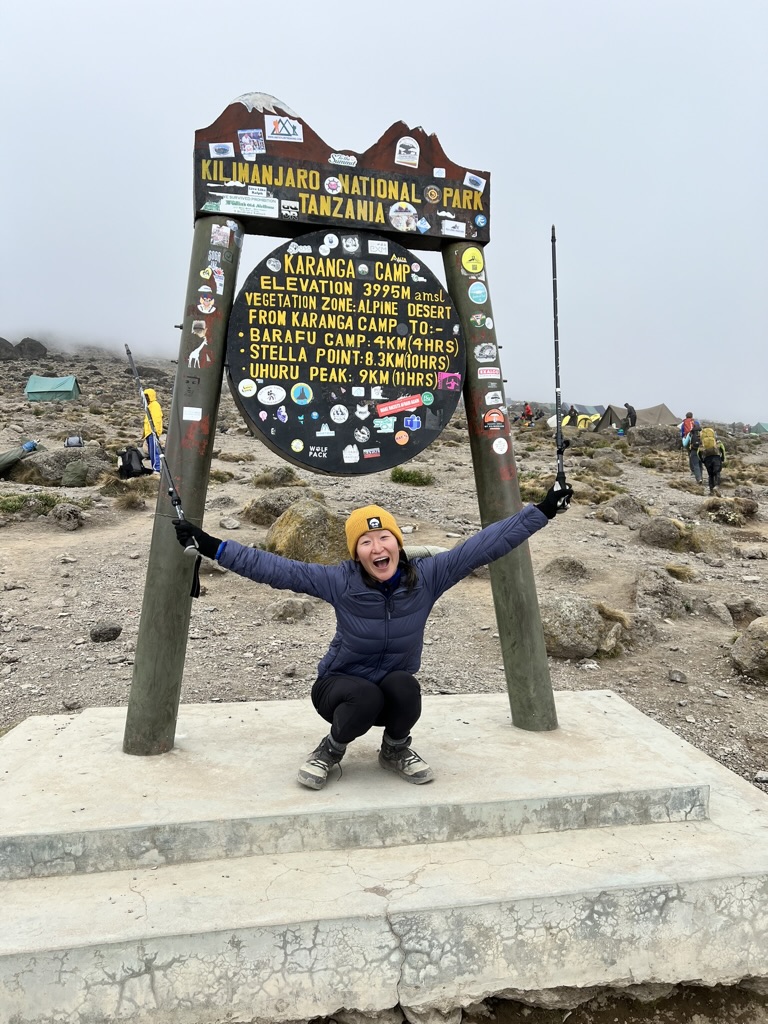
Day 4 Destination: Karanga Camp (Elevation: 3995m)
After a rough Day 3, I was thrilled that I woke up Day 4 morning well-rested and feeling good! Another raving endorsement of Diamox and Advil.
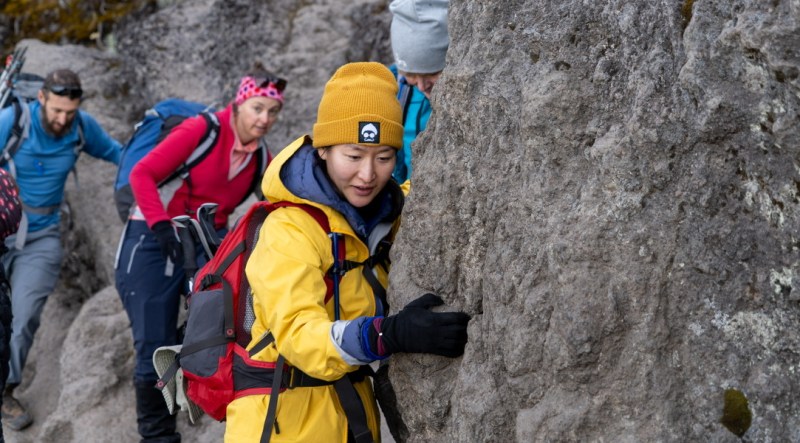
Day 4’s trek, scaling the Barranco wall, was my favorite segment of the entire Kilimanjaro trip by far. I realized that I have distinct love for scrambling up and down rocky hills.
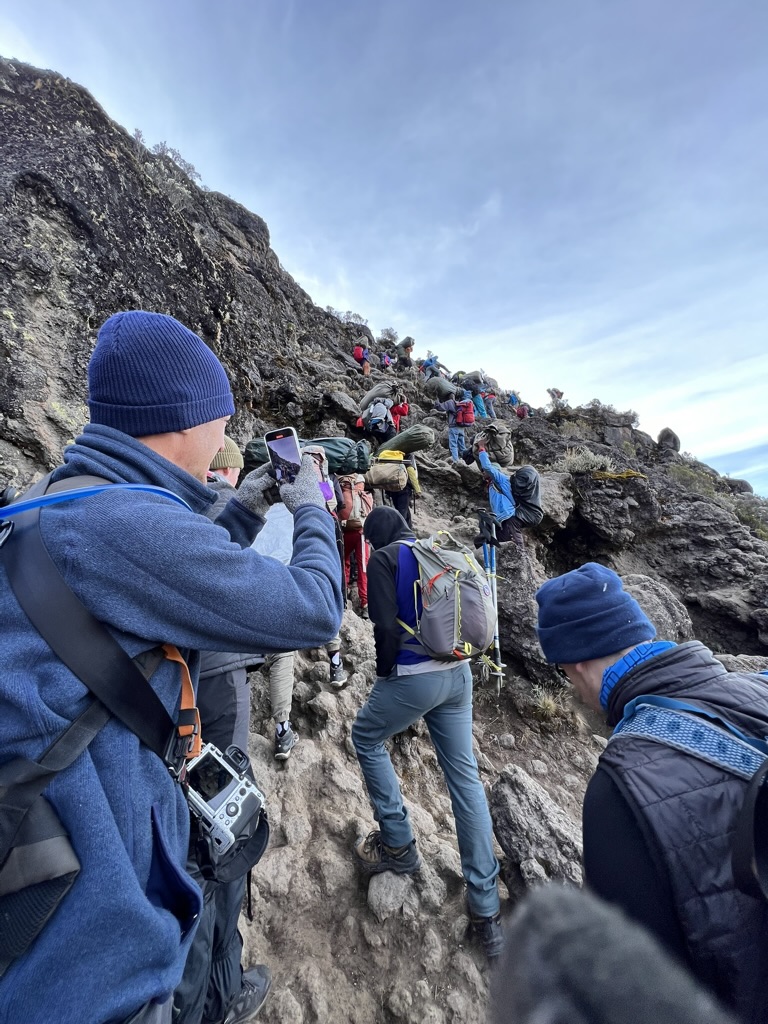

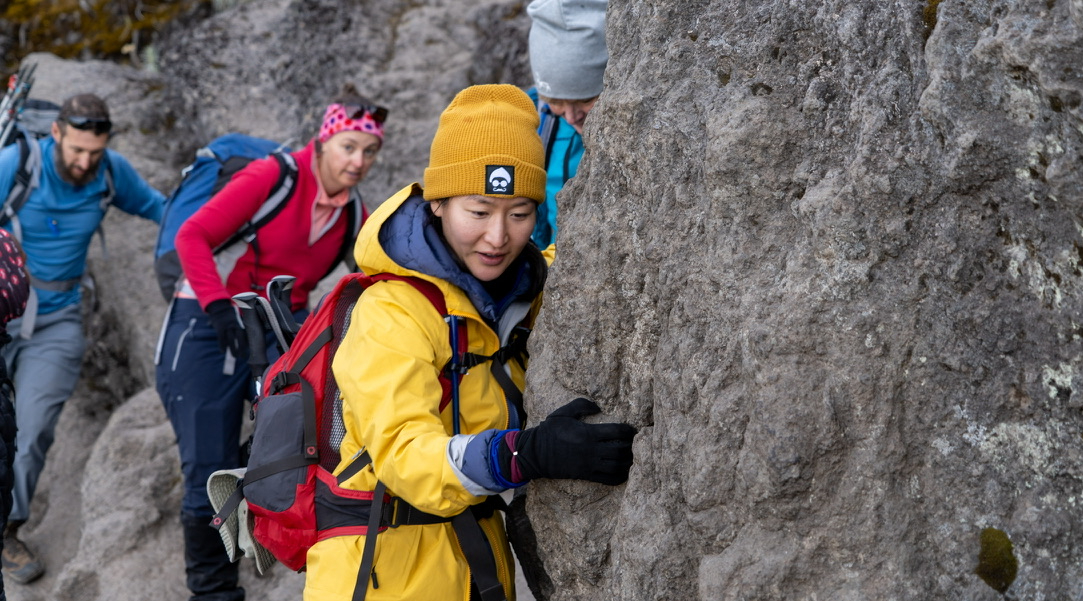
That photo above is of me passing “kissing rock” which is a part of the scramble where you had to basically hug (or kiss 😉 ) a boulder to safely proceed.
Our portersheroes coming down to grab our packs to bring up to the camp 🥲:
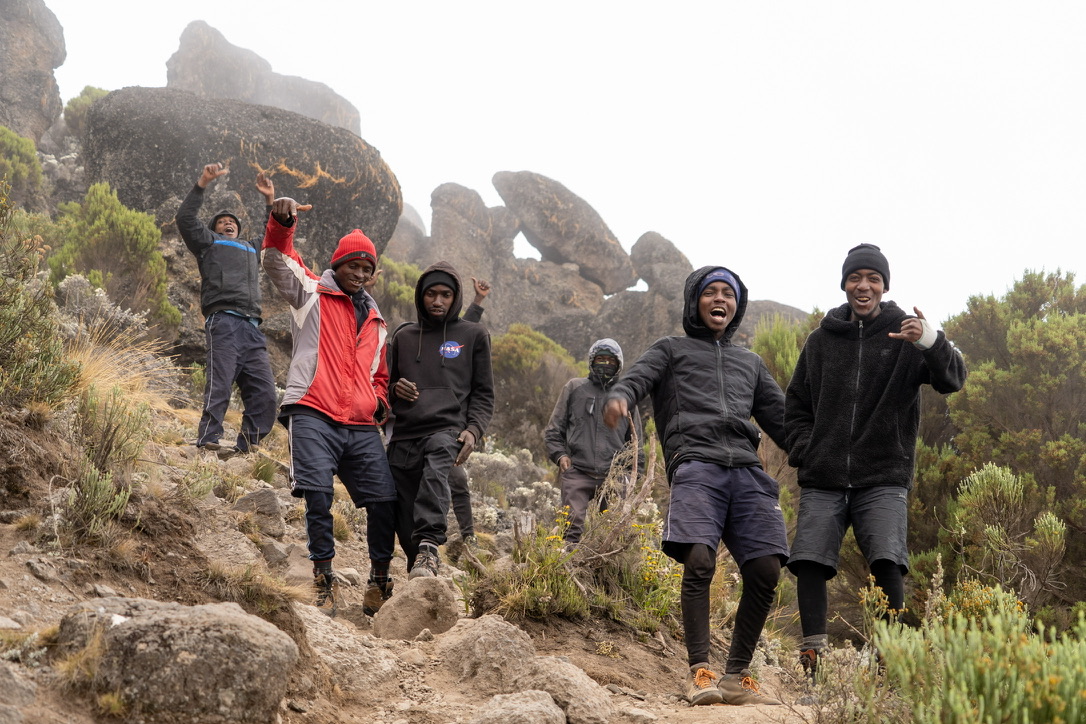
We had a very short day of hiking that day, getting to Karanga camp in the early afternoon.
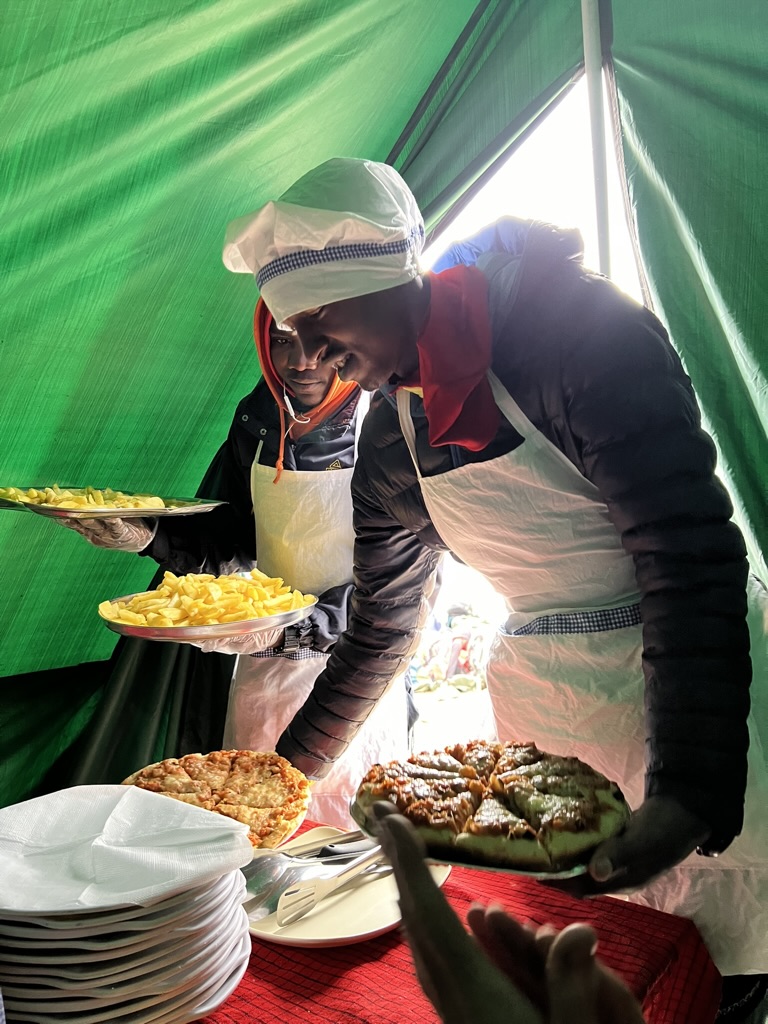
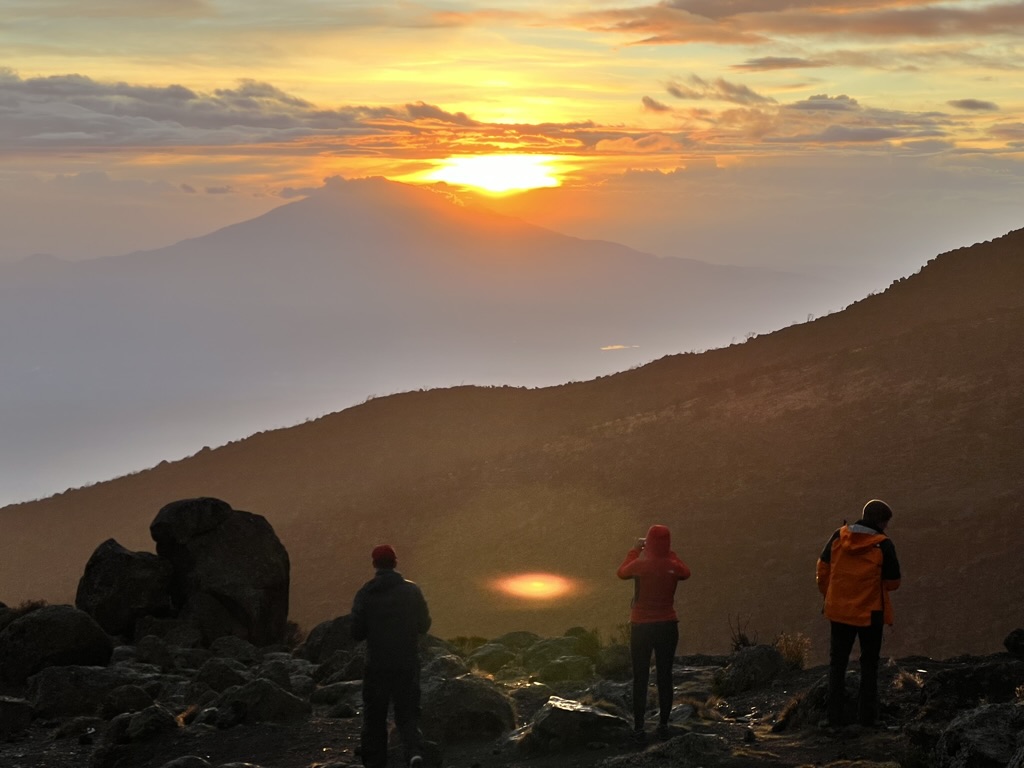
At lunch they served us PIZZA AND FRIES?! (like, how do you make pizza and fries in the wilderness, y’all. And also their chef outfits were the best LOL). With the time that we had that day, while it was raining cats and dogs outside and we were cozily sheltered in our mess tent, our guides gave us an overview of Tanzania, recounting its history, society, and culture. We paused our lecture midway to marvel at one of the most beautiful sunsets I’ve ever witnessed. Funny how the best sunsets come after torrential downpours. (metaphor)
Day 5 Destination: Barafu Base Camp (Elevation: 4673m)
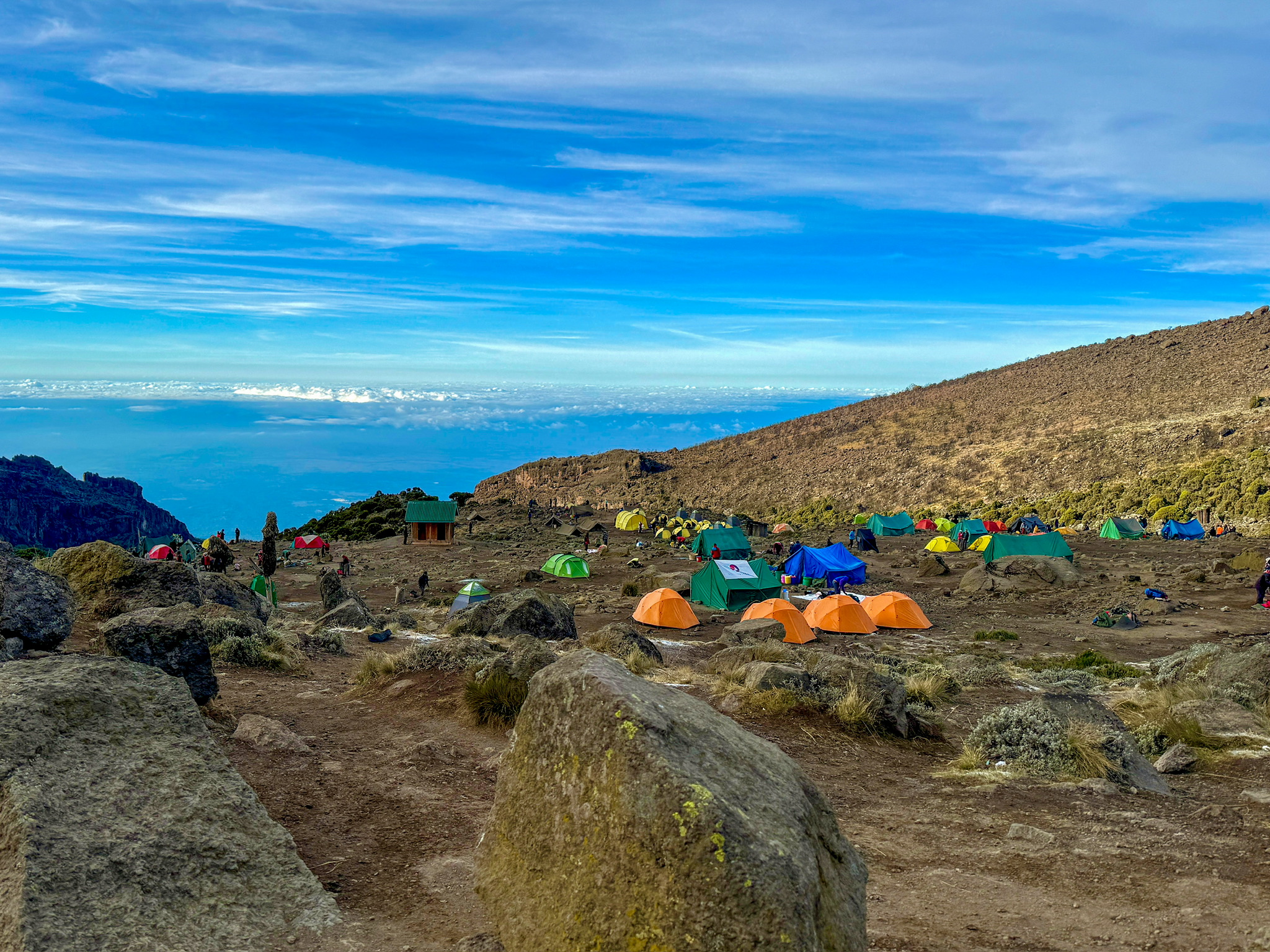
Short quick hike on Day 5 to Barafu camp a.k.a. BASE CAMP, BABY!!!!!! Some of my fave photos of the trip taken by Jason on this day:
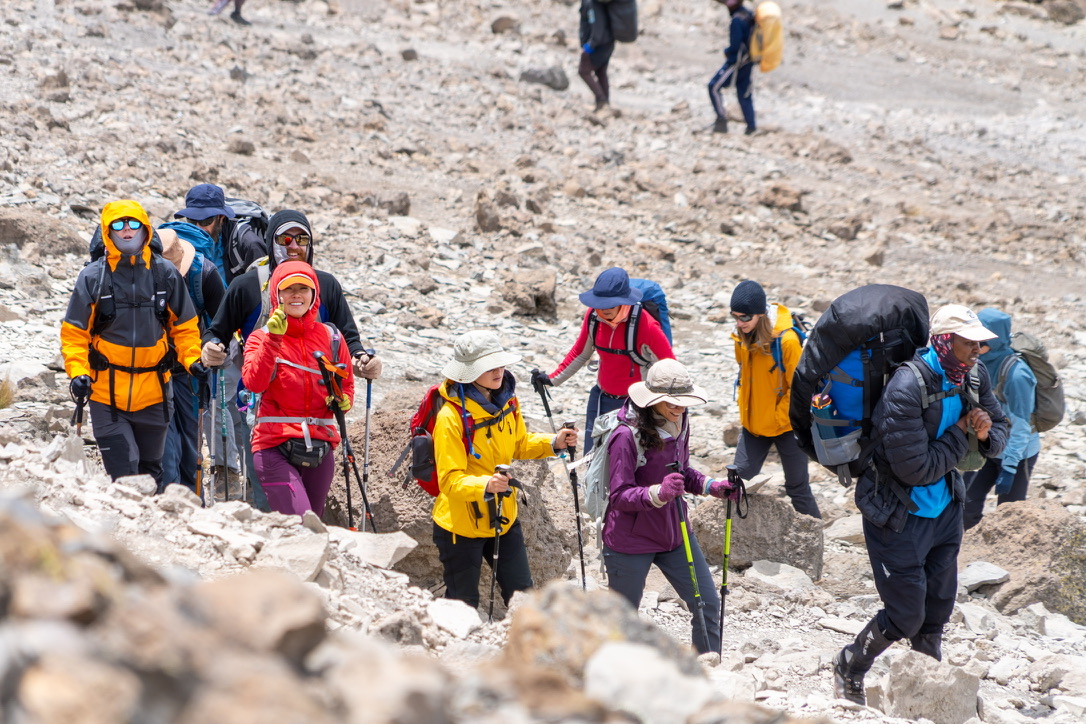
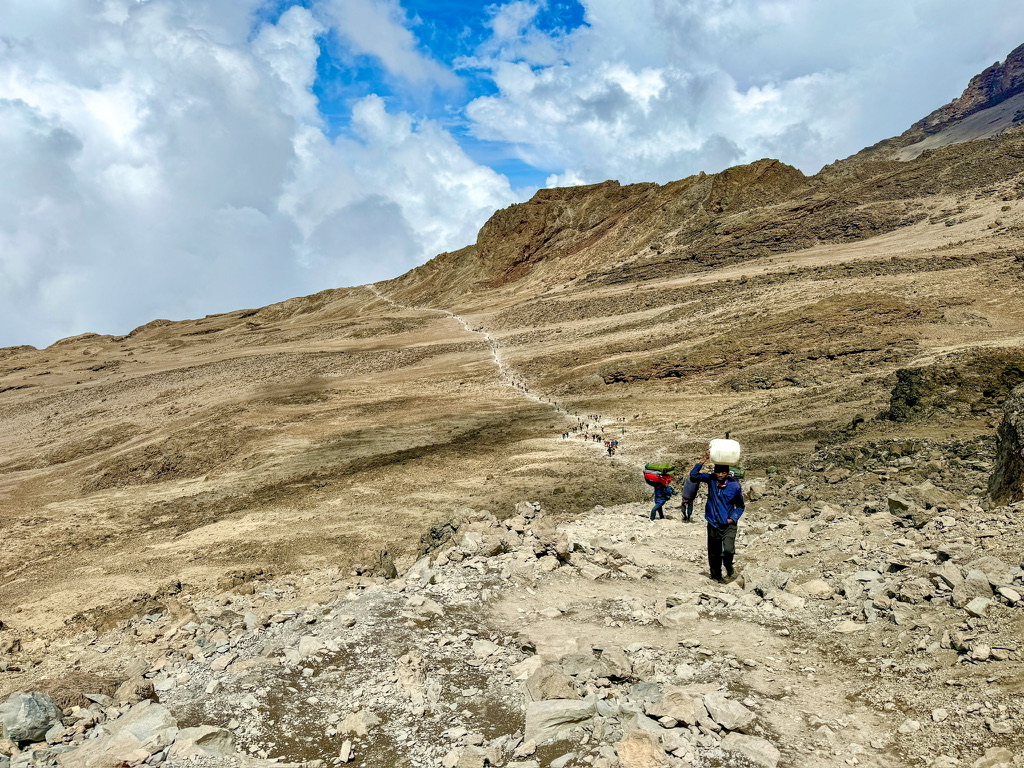
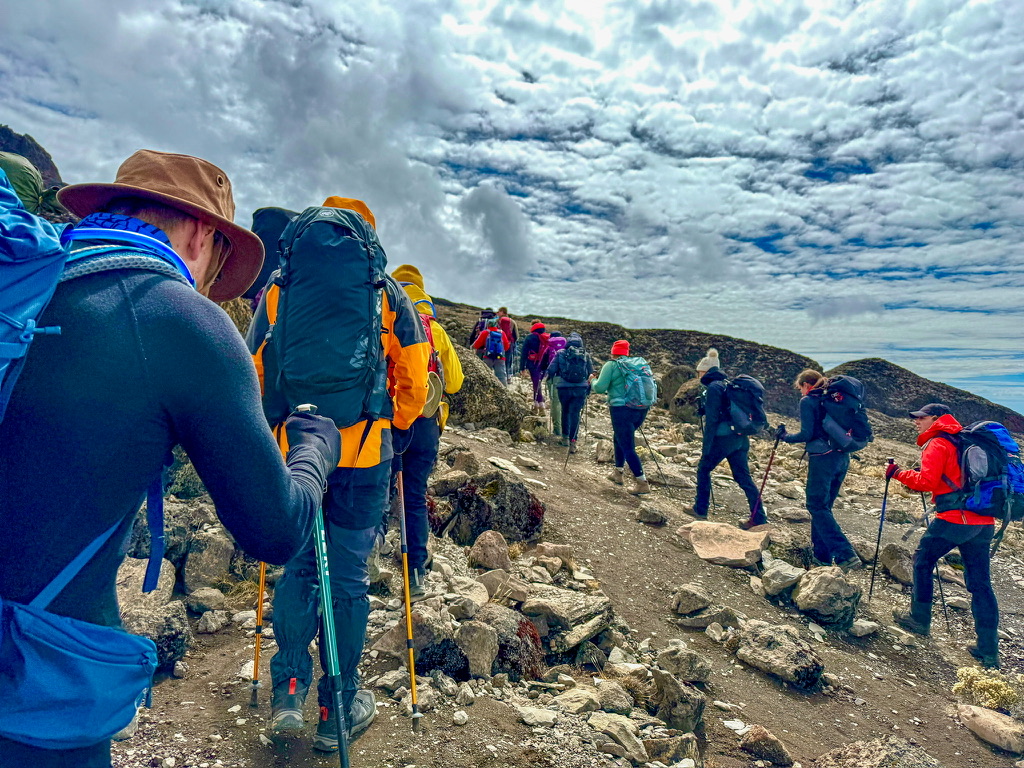
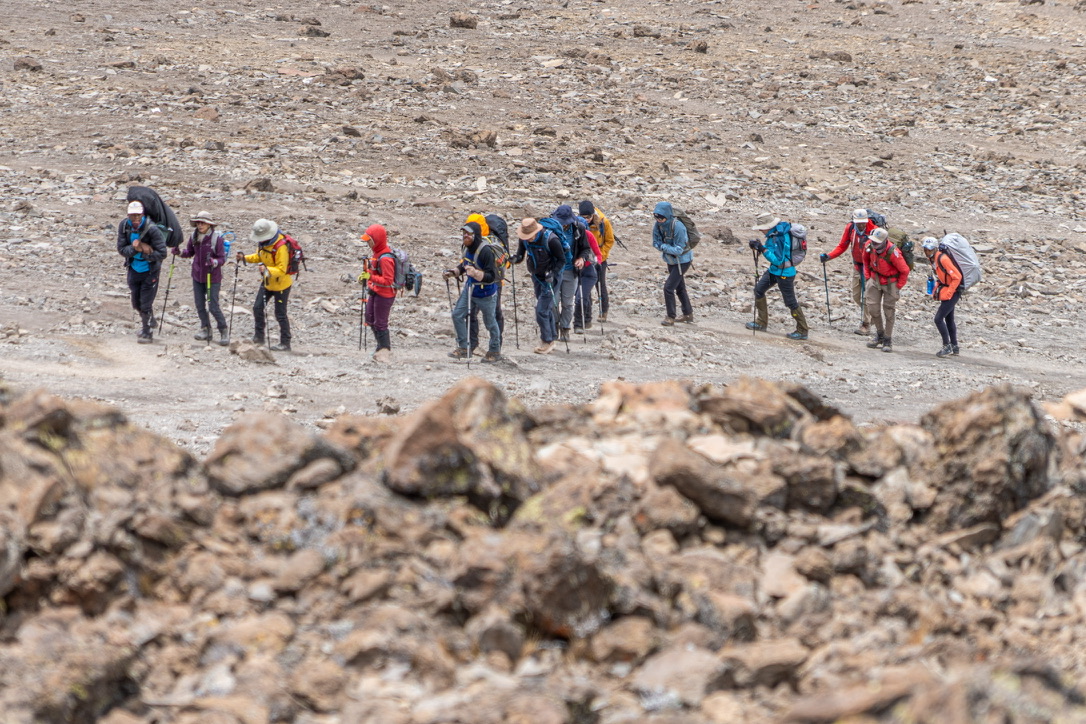
A few members of our trekking group struggled this day because we were really climbing in elevation (ending at 15.3K feet). Copious amounts of nausea, headaches, and indigestion, yet everyone pressed on. One team, one dream.
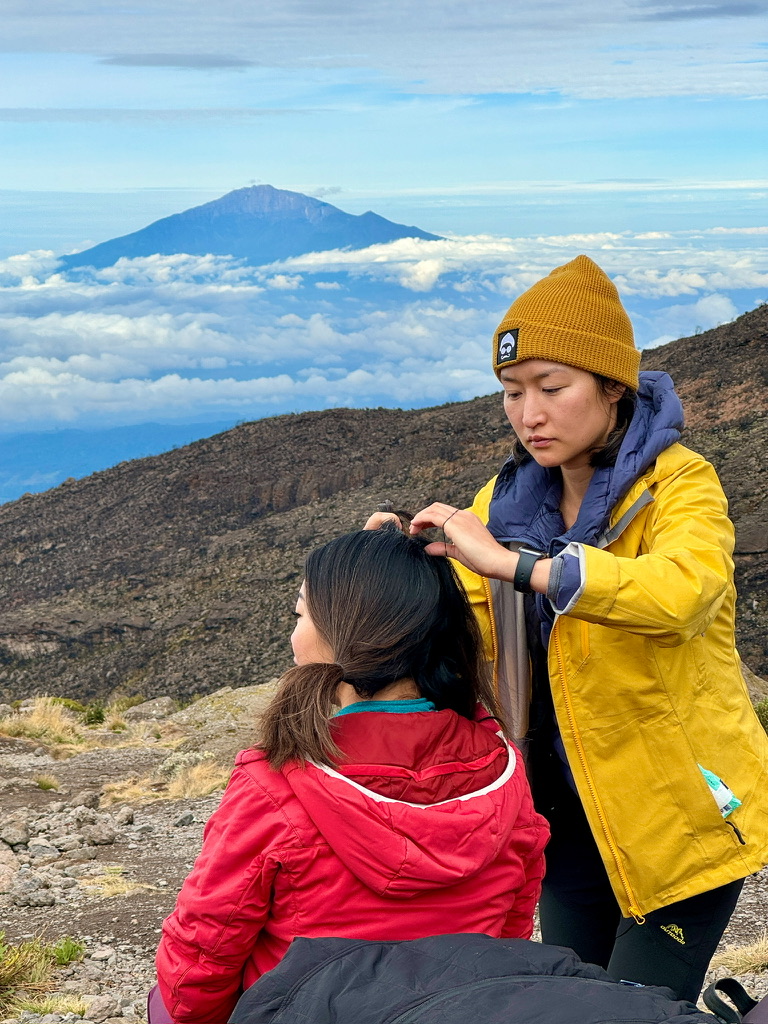
Quick-break-turned-Mendi’s-Hair-Salon!!!! ⭐️⭐️⭐️⭐️⭐️ Great views, great service!
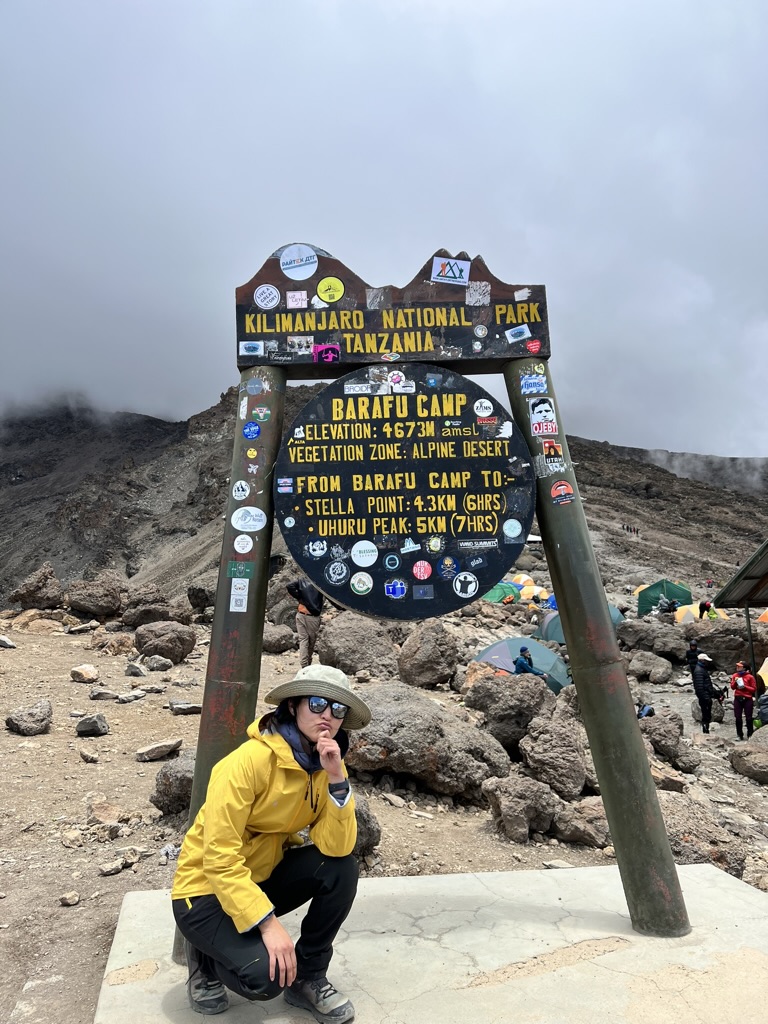
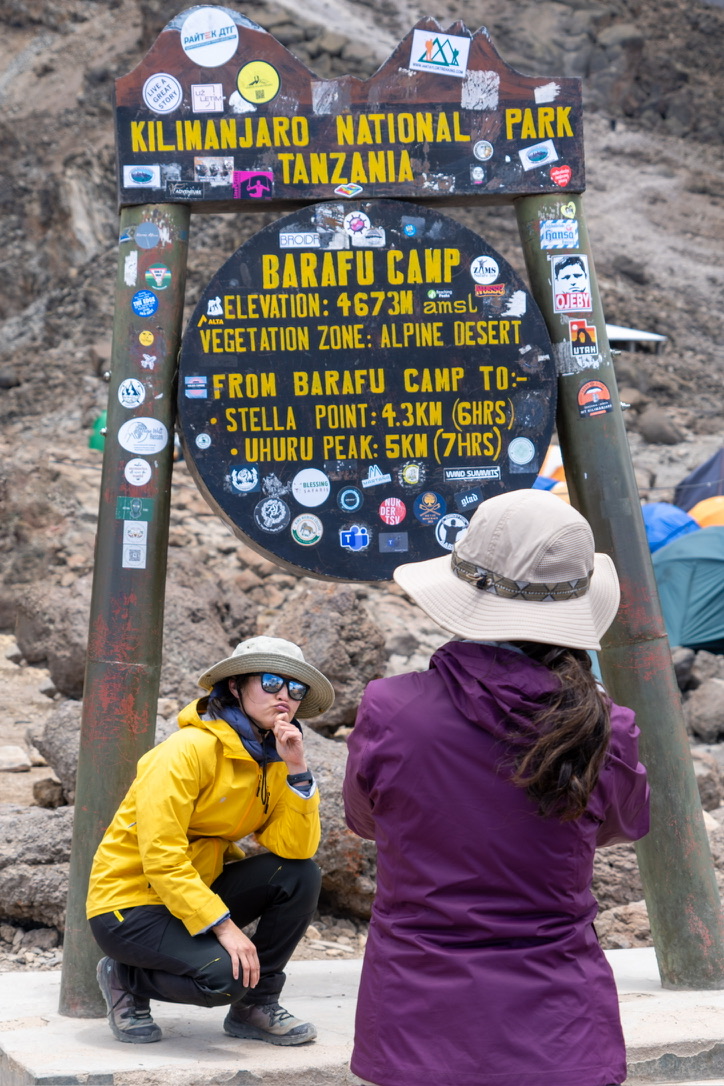
We wanted to get to Barafu quick that day because our 17-hour summit push was going to start at 10PM/11PM that night, and we needed to get to bed by ~7PM. Here is my cliché camp sign photo (and Jason’s BTS shot 😂):
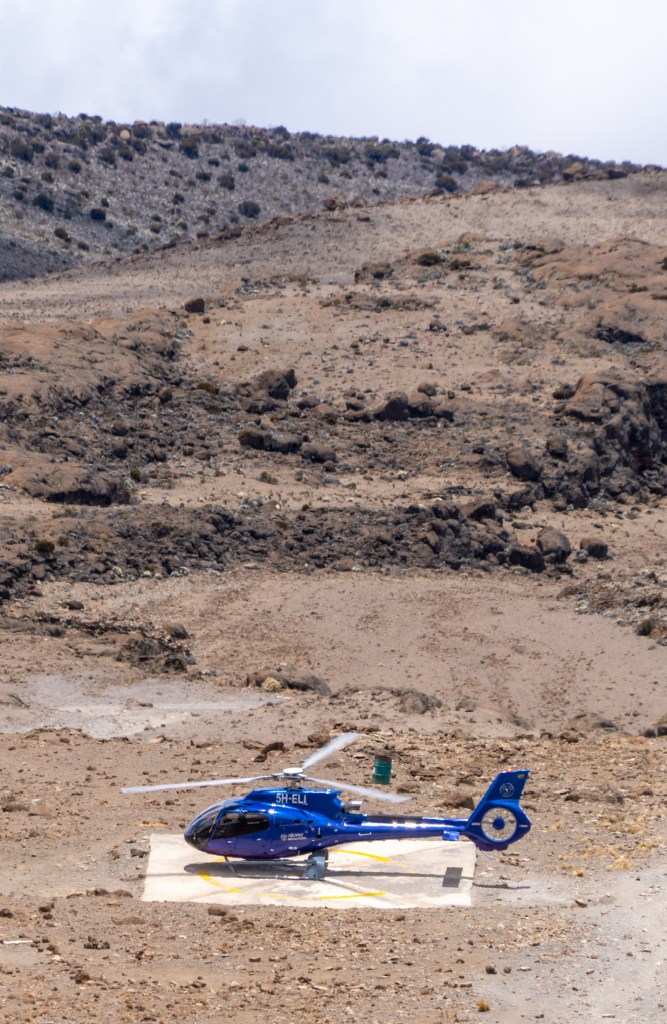
TBH did not love seeing a rescue-heli at base camp…………..
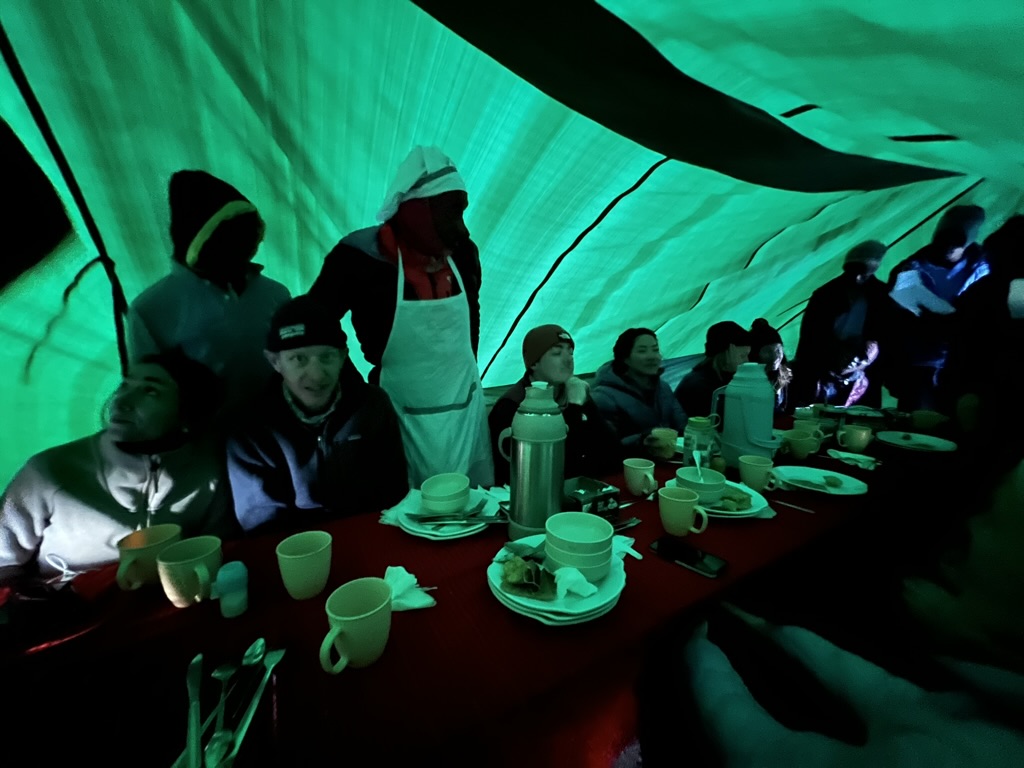
We had dinner at 5PM, followed by a particularly somber briefing about the summit push. You could feel the nerves and anticipation in the tent. All 7 of the guides would join us to the summit, as well as 6 of our porters. One “support staff” per trekker. They didn’t have to tell us why. We knew why. It was in case any one of us came into a health risk situation.
My fave quotes from Isack, our head guide: “No sweat, no sweet.” and “Stay positive, and you will visit the roof of Africa.”
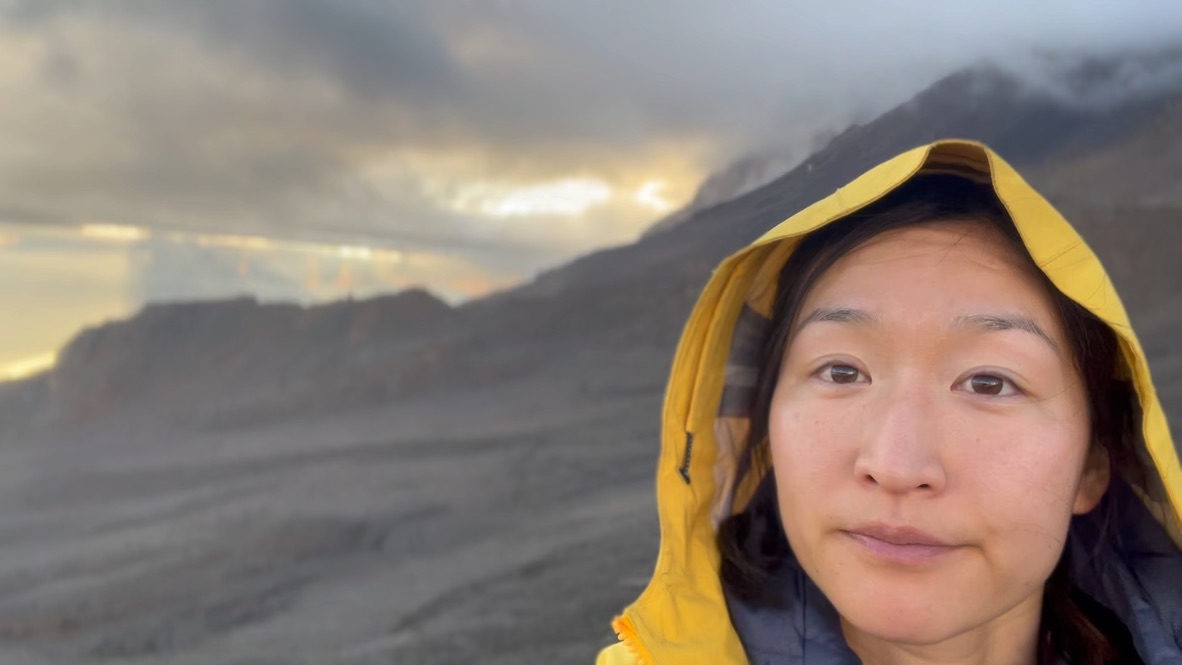
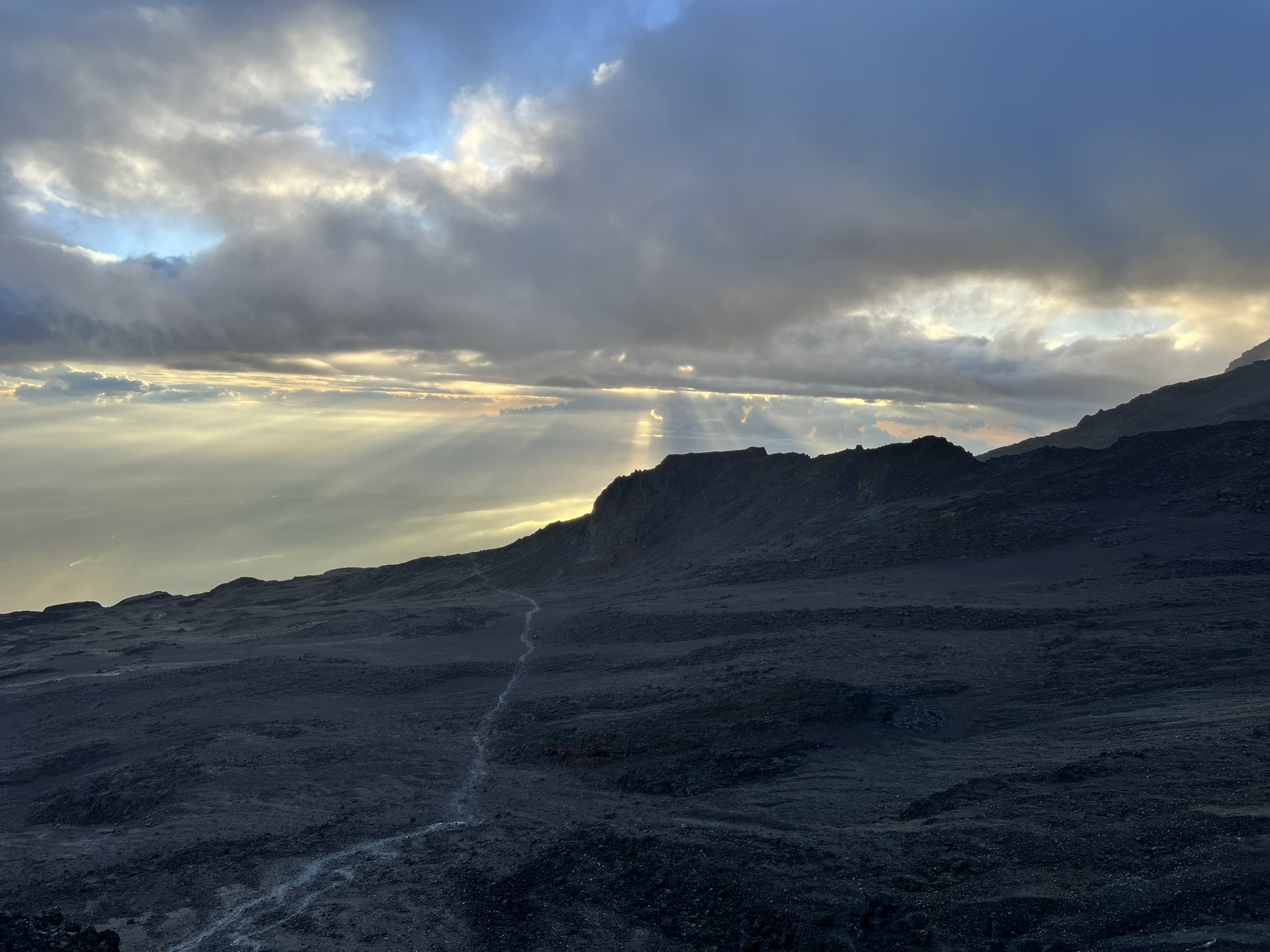
Pre-7PM-bedtime-sunset:
TMI (sorry not sorry), but let’s just say I was incredibly grateful that despite “total blockage” between Days 2 and 5, I was able to relieve my digestive/gastro woes BEFORE the summit push. I feel like that would’ve been disastrous otherwise.
Per guidance from Isack, for summit we needed to wear 5-7 top layers, and 3 bottom layers, THICK socks and gloves, and all the warm hats we had access to. I felt like the Michelin man, wearing 80% of my layers and wriggling into my sleeping bag that night.
I slept not a wink because I was a mess of emotions. Nerves, excitement, fear.
Day 6: SUMMIT Uhuru Peak (Elevation: 5895m), descend down to Mweka Camp (Elevation: 3100m)
… WAKEY WAKEY EGGS AND BAKEY! We woke up at 11PM, ate a few crackers and pieces of popcorn, and off we went to CONQUER THIS DANG MOUNTAIN.
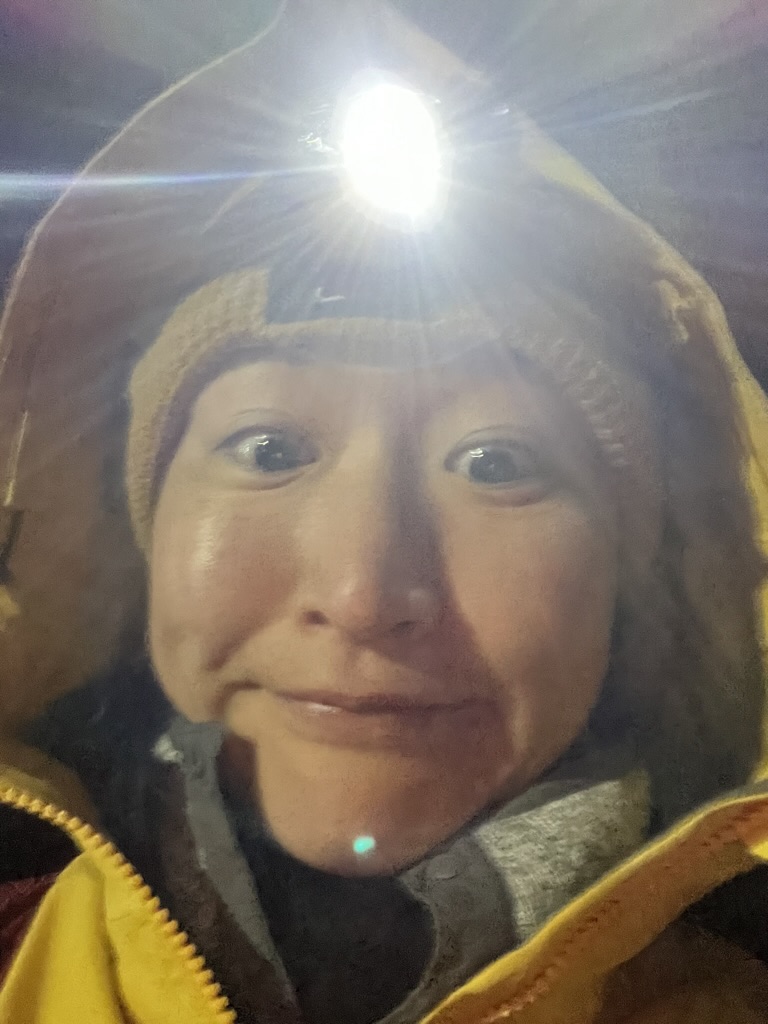
To say <five grueling hours of “pole pole” hiking in the pitch black darkness heading straight up a mountain with no end in sight other than the string of headlamps you see in the far distance> is torture – is an understatement.
Corporal punishment. I could immediately see why during last night’s briefing Isack wouldn’t stop saying “stay positive“.
Though I don’t have exact temperatures handy, I estimate that we started off a reasonable 25 degrees F at 11PM and as we ascended the mountain, the temperature plummeted rapidly. By 3AM, temperatures could’ve easily been from 0 – 5 degrees F, without taking windchill into consideration. The winds are particularly piercing as you’re just about to lose feeling of your face.
I also recognize it is a privilege to now know what snot-icicles feel like.
My hands and feet also slowly lost feeling, as I struggled to keep them moving. Despite the physical challenges with the altitude – my labored wheezing after I took a larger than normal step – this climb felt like a mental game more than anything.
Let me also say that popping a squat at 18,000 ft. elevation at zero degrees F and amidst tempestuous winds is not my favorite. At least if it’s pitch black, you can pee pretty much anywhere on the mountain (though you pray no one shines their headlamp your direction).
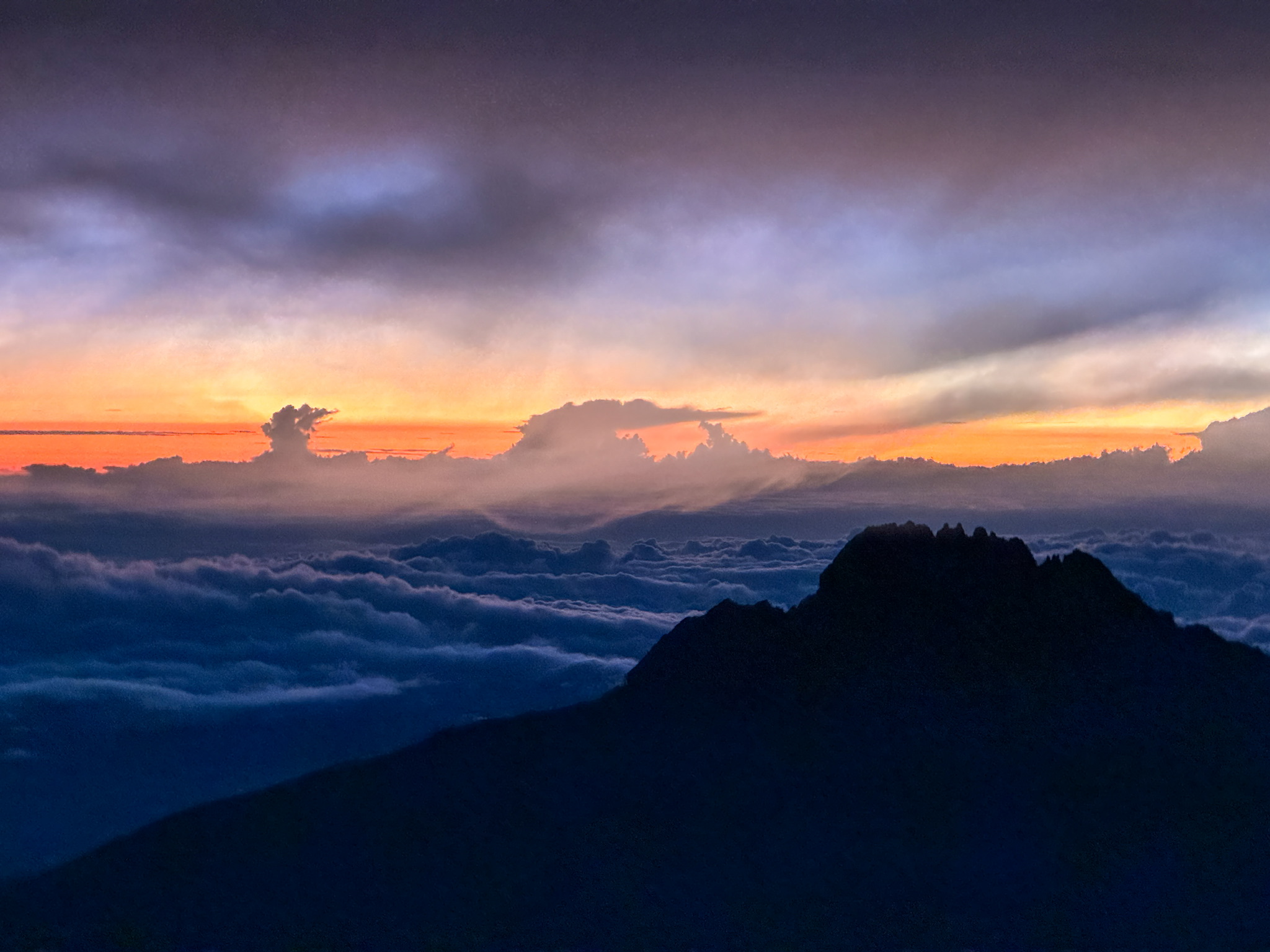
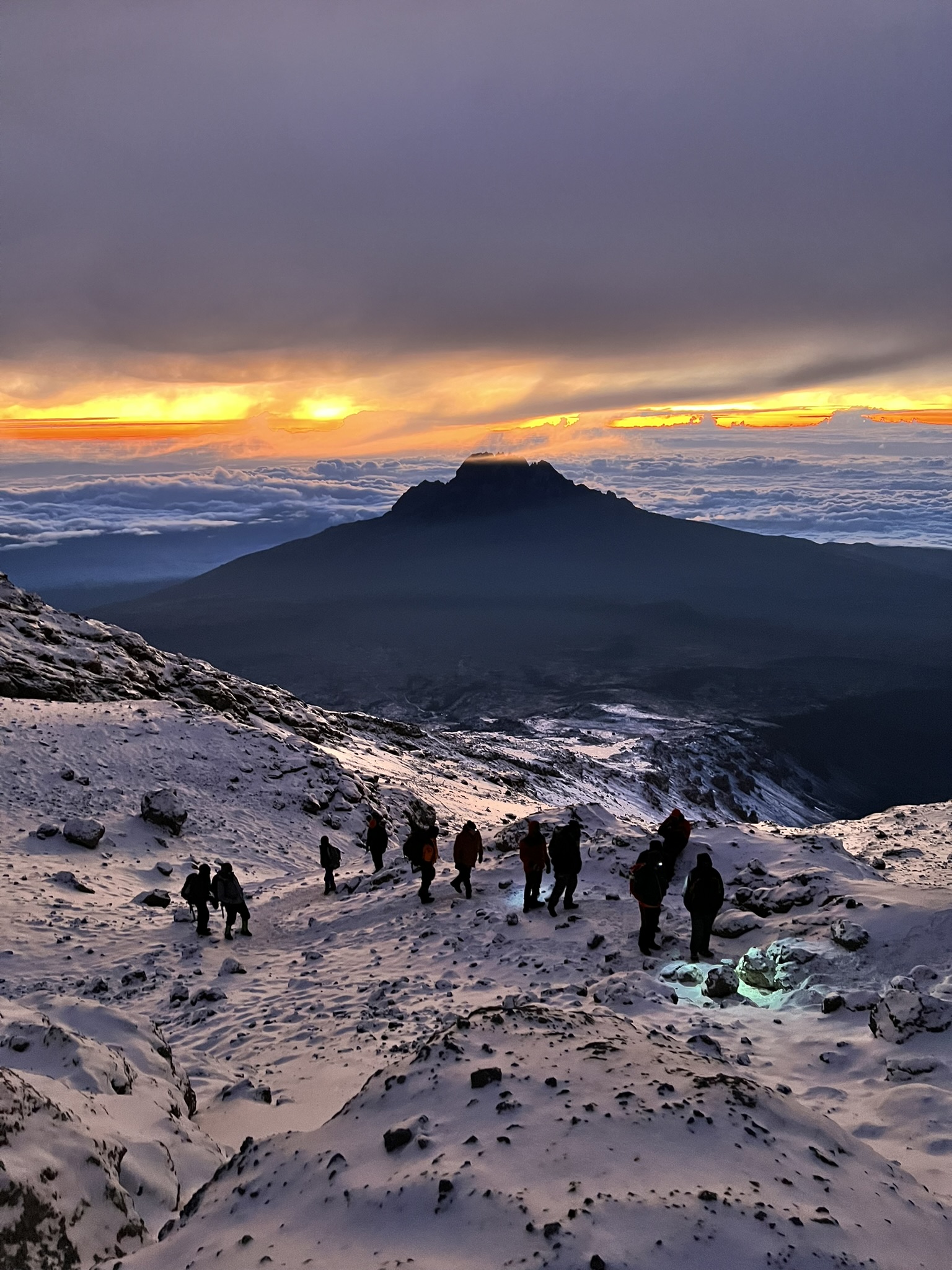
I cannot put into words my emotions when we saw our first glimpse of sunrise that morning.
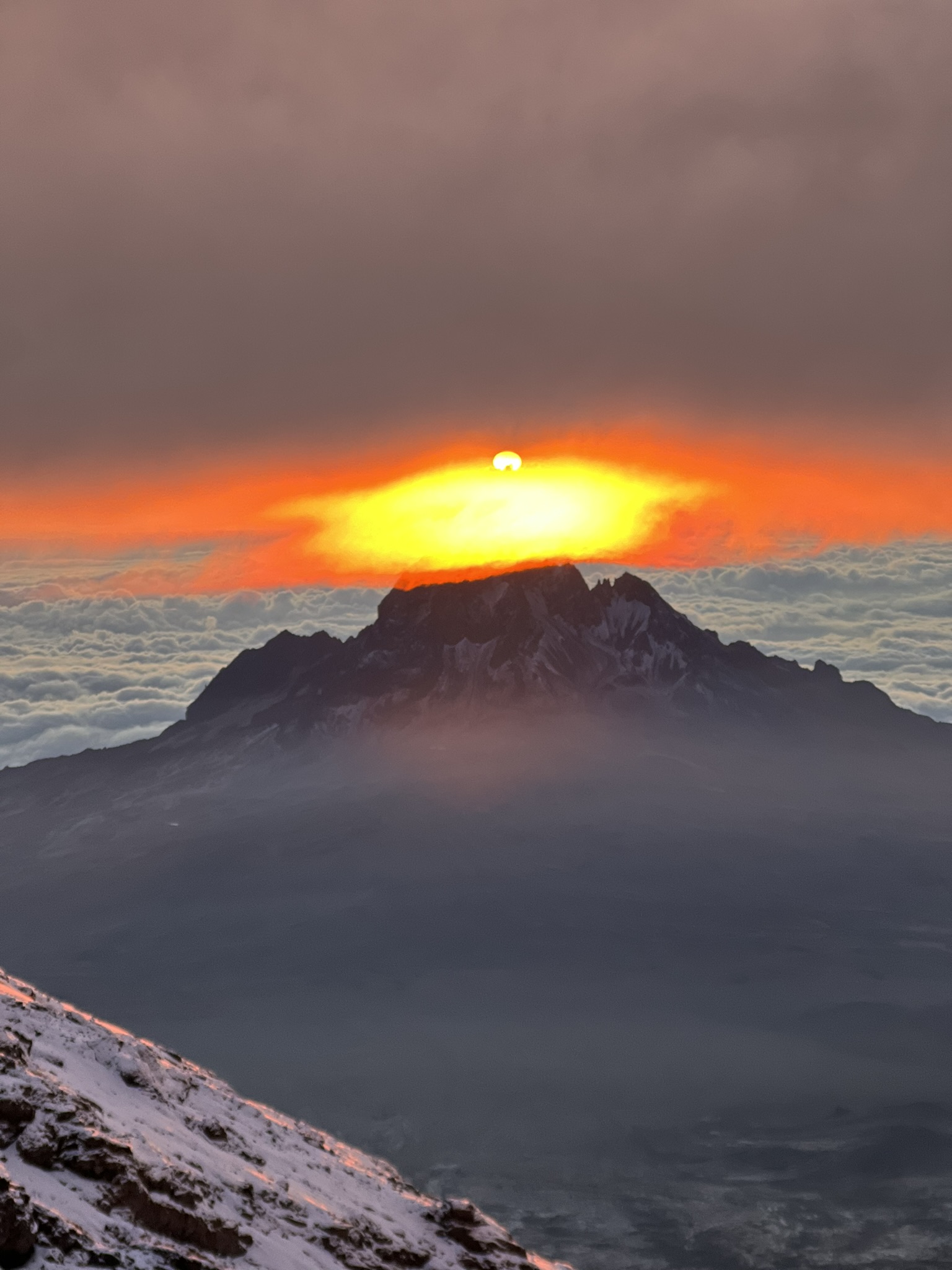
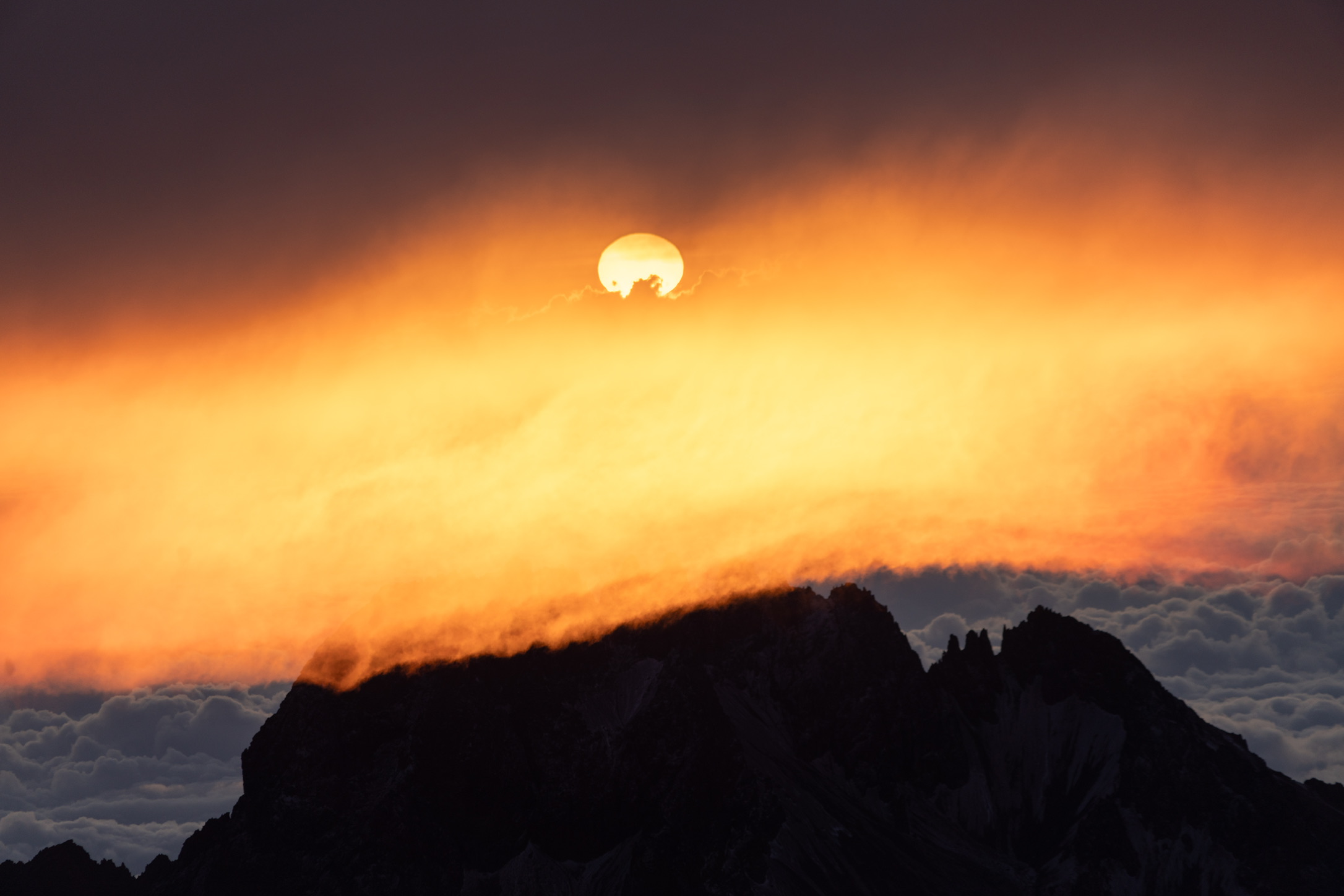
One of our guides, Dula, ended up taking my backpack, despite me stubbornly wanting to keep it. I told myself: Leave your pride at home, Mendi. In retrospect, I am so grateful for Dula because I’m not positive I would’ve reached the summit if he didn’t.
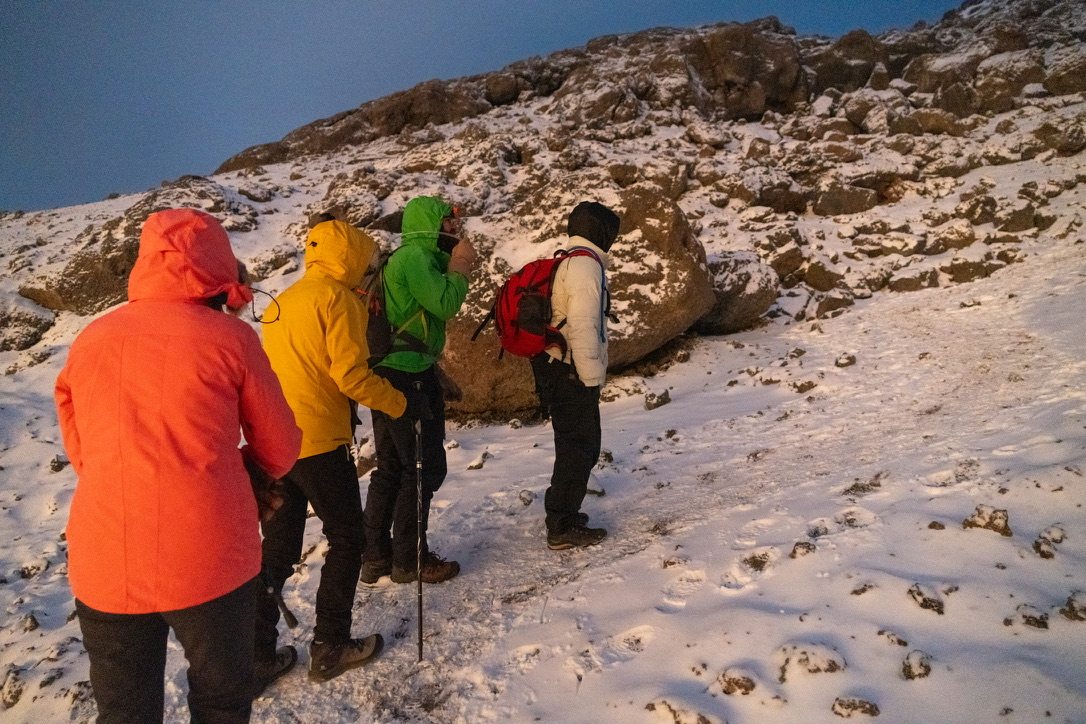
Given the harsh conditions, our trek group ended up splitting up. If it wasn’t clear before, it was crystal clear now why we needed one support staff per trekker.
Around 6:15AM (this was after ~6 hours of hiking straight up), we had reached our first checkpoint of the day, Stella Point (elevation 5756m).
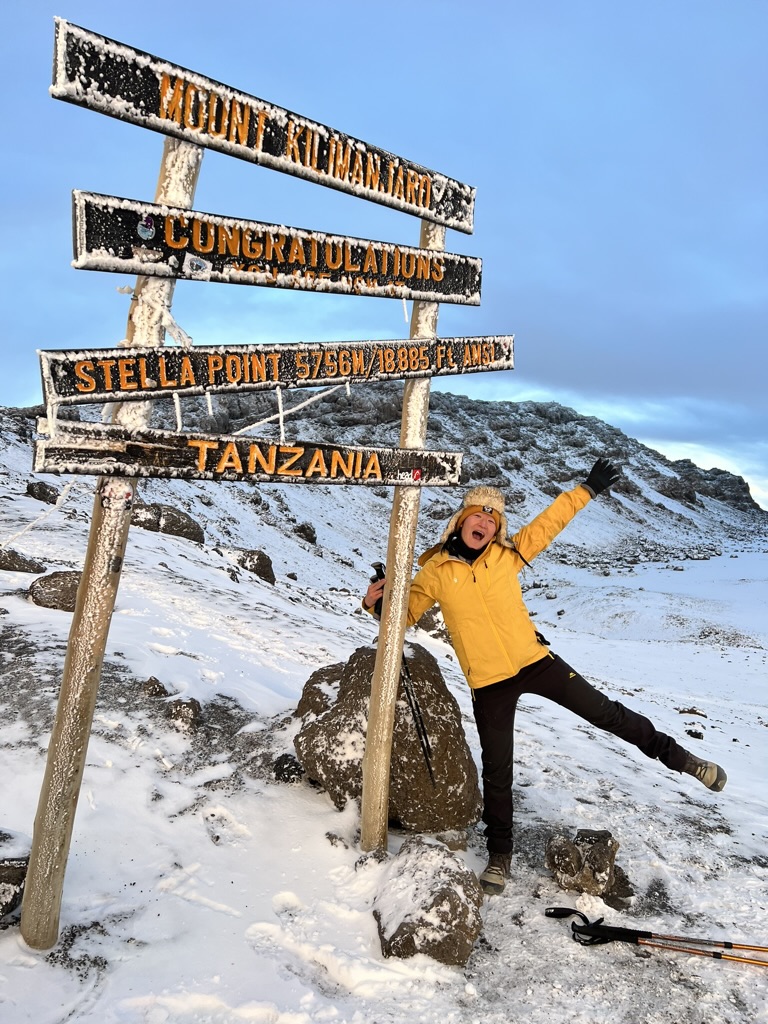

We couldn’t celebrate for long (given the temperature and winds), so we had to keep going up. We passed by some ridiculous glaciers and clouds along the way.

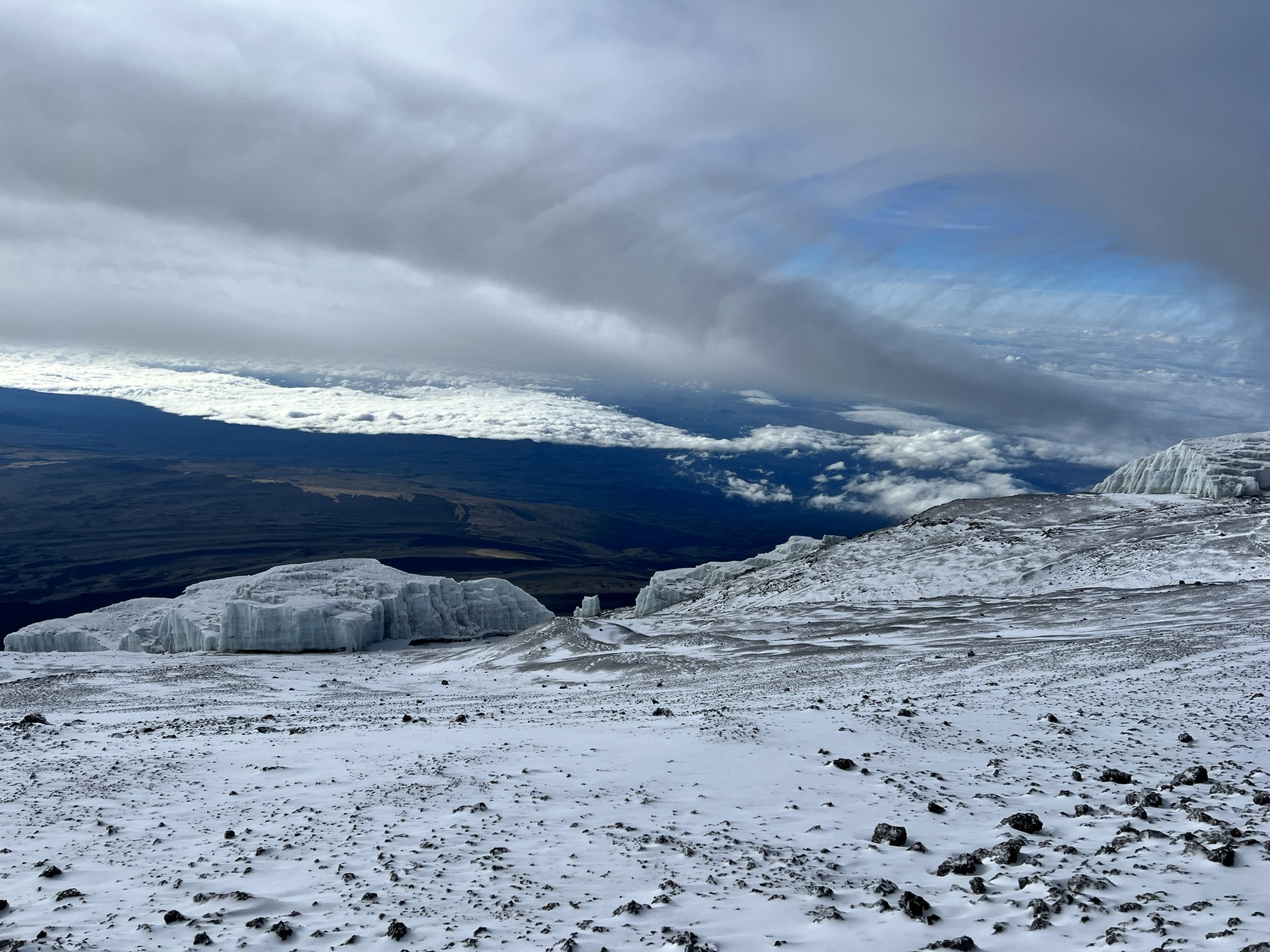
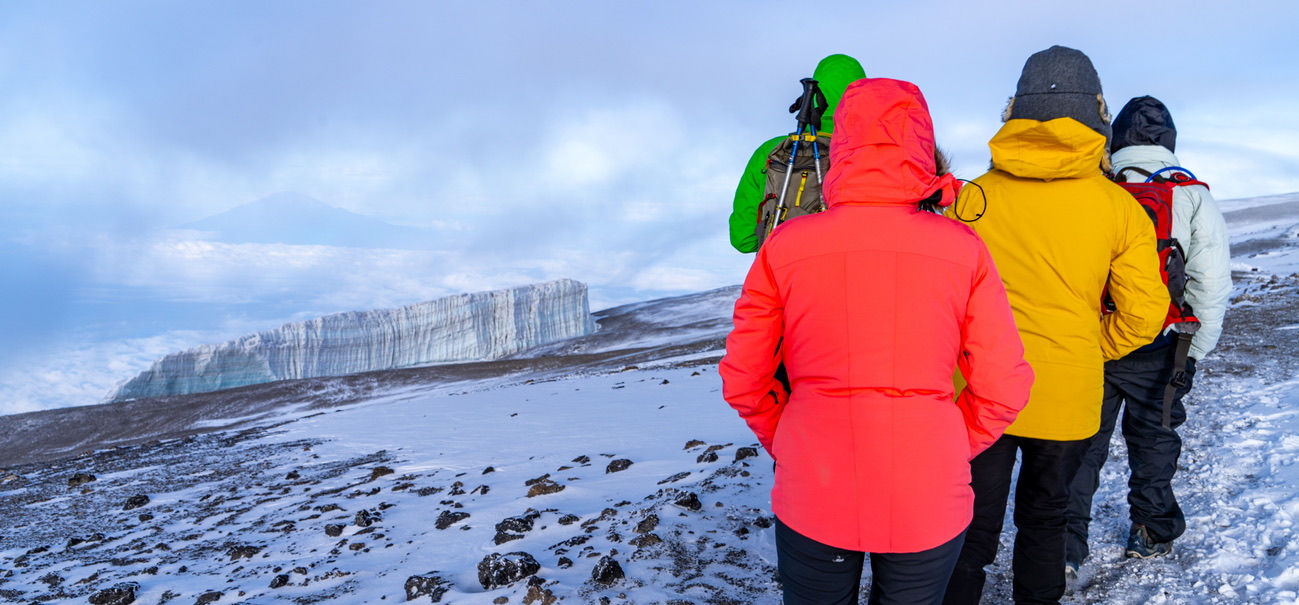
…… and at 7:10AM on October 19th, 2023, we reached Uhuru peak and successfully summitted Mount Kilimanjaro.
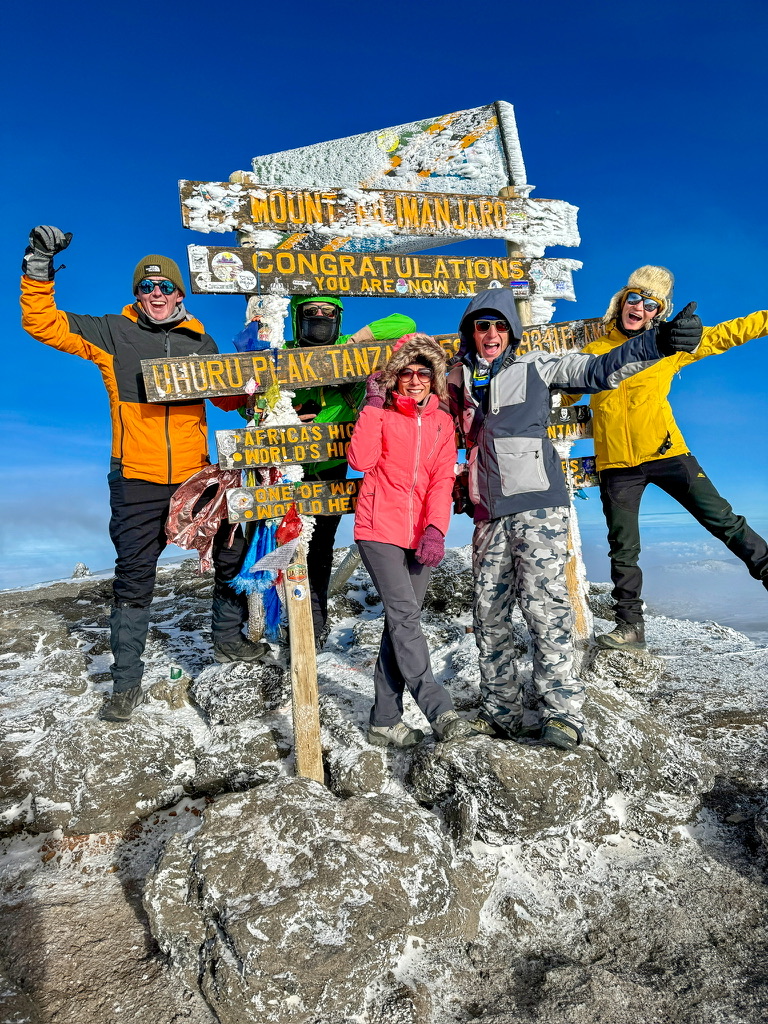
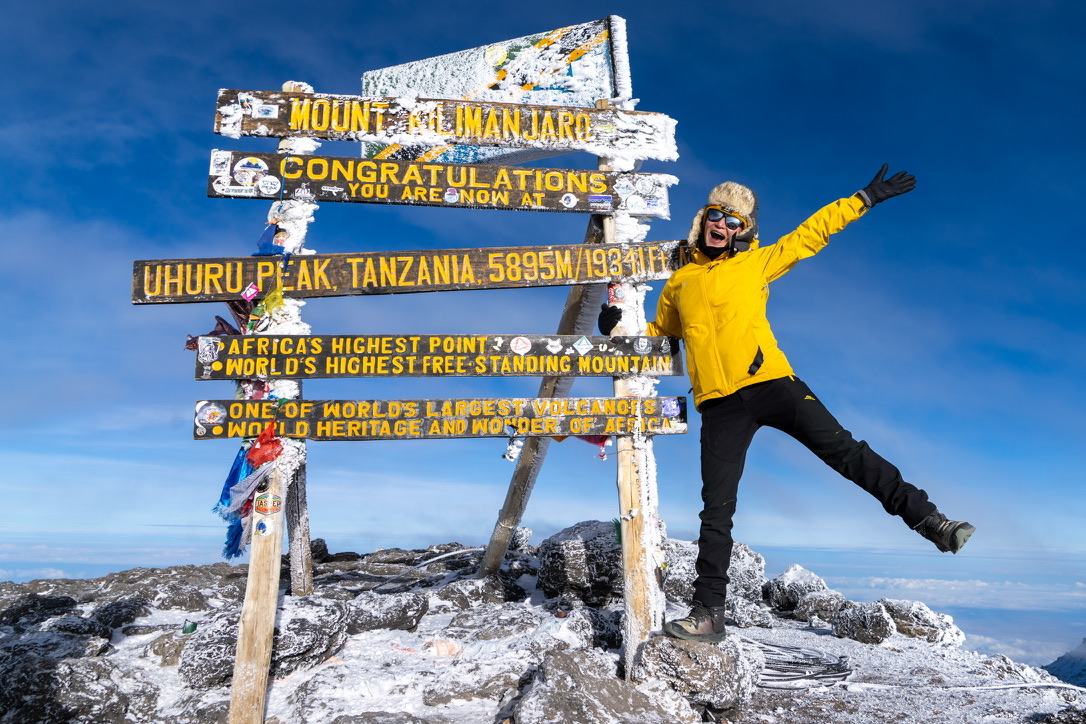
What happened at the top was honestly a blur: Given the frigid temperature and unrelenting winds at the top, the guides were in a RUSH. “It’s too dangerous to stay up here.” We took a grand total of 3 minutes snapping photos with the famed sign, barely celebrated, and down we went.
(I was approached by one poor stranger whose phone froze in the ascent, so I took a photo of him with the sign and sent it to him after we got back to civilization. After all – did you even summit Kilimanjaro if you don’t have a photo with the sign? 😊)
It’s funny how quickly you say “fuck pole pole” when you’re trying to cheat frost bite. The good thing is that you don’t really need to go slowly down in altitude because you’re body is basically like “oh thank you, more oxygen.”
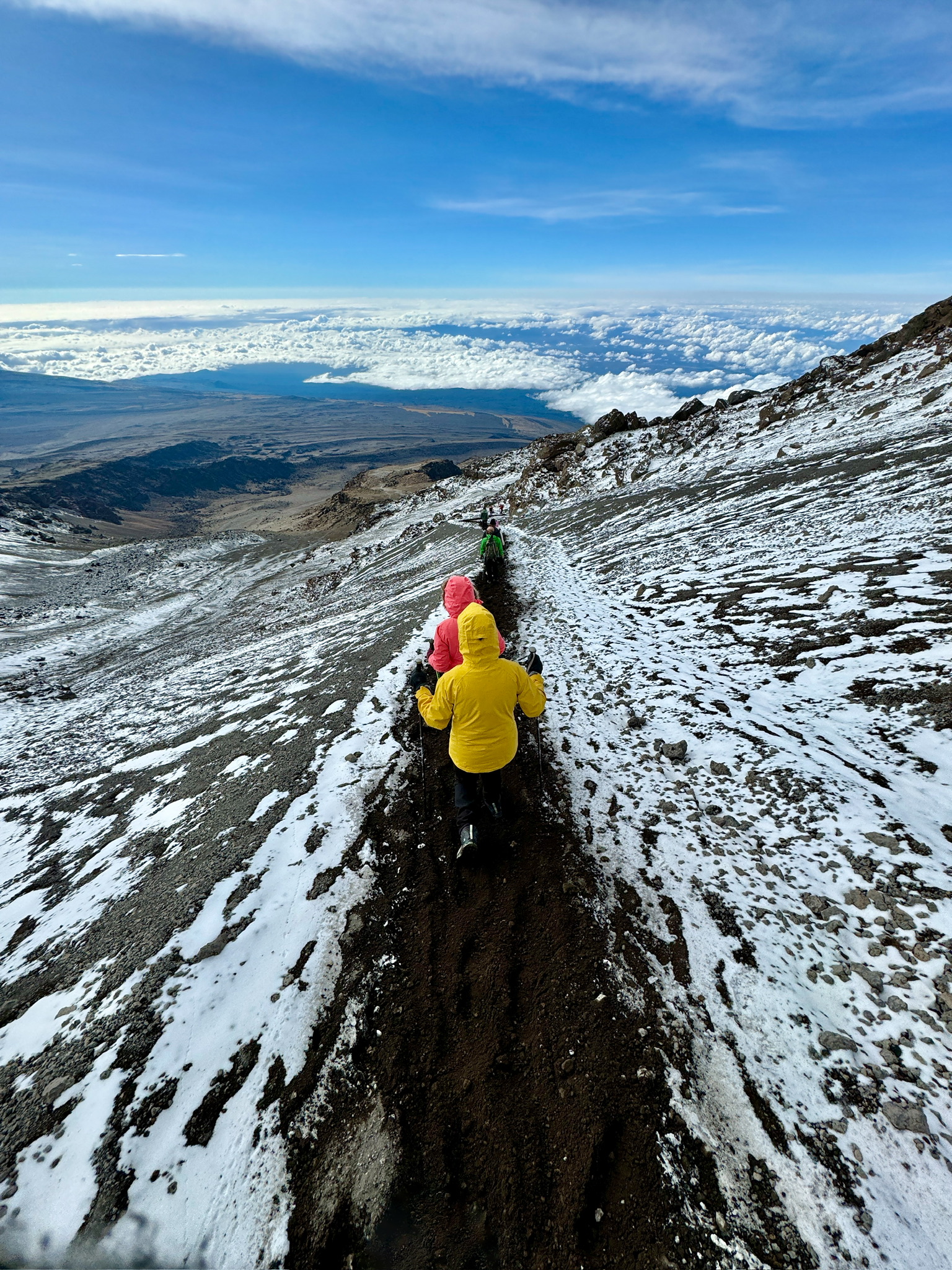
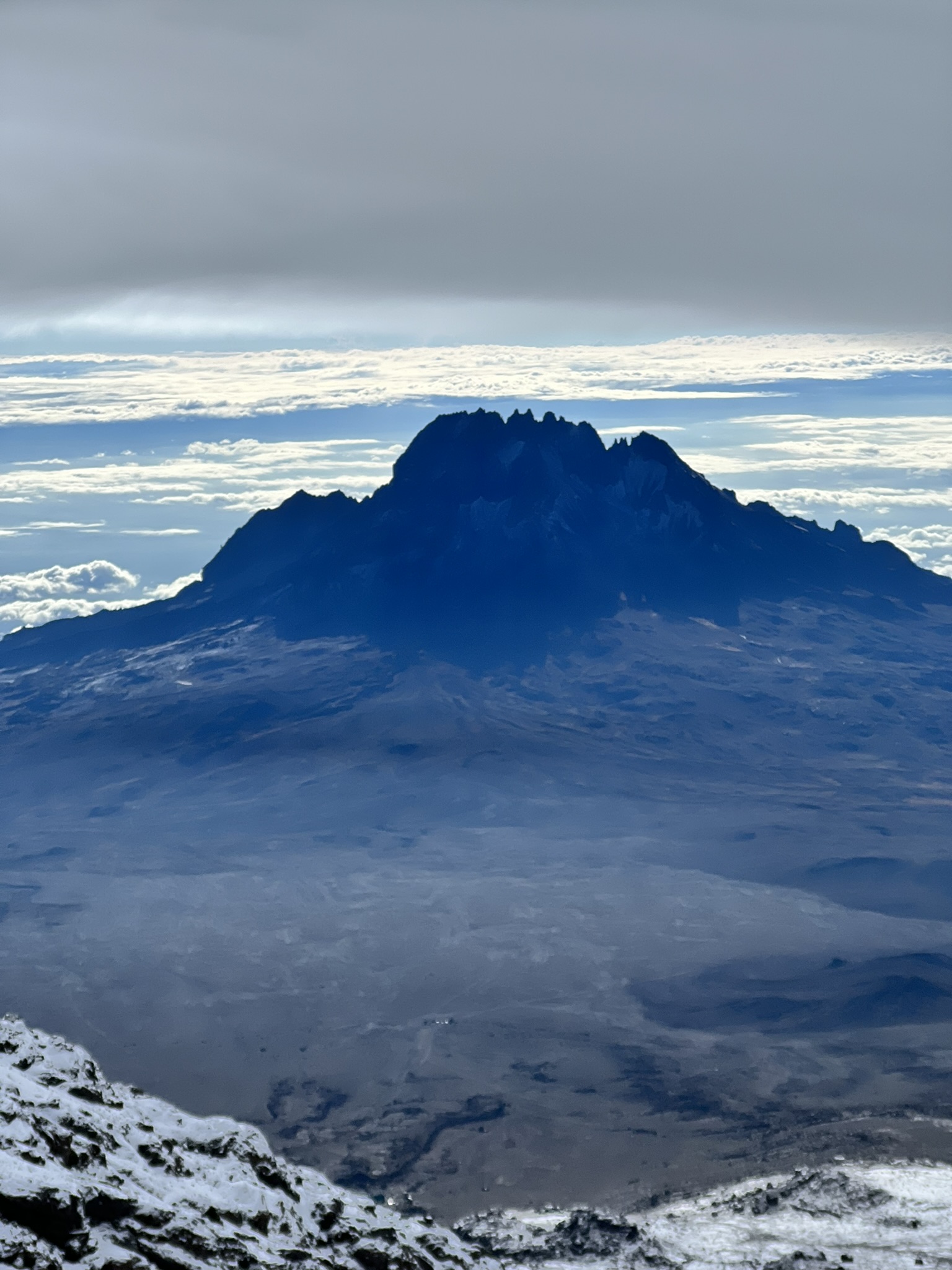
I lost Dula on the descent, so I basically had 3 hours without my backpack/water (not that it would’ve mattered anyway; my water was frozen solid). Thank goodness Asli and Jason saved me with an extra water bottle they had 🙏.
Having literally GALLOPED down the mountain (my poor knees), we reached Barafu base camp again around 10AM. High fives all around from porters and guides. Success photo with me and Asli! 💕

The guides told us we could nap for 2 hours before lunch and continuing our trek. Oh how generous. I think my body was reeling from trauma “wtf did you just do to me” (the entire past week, but also specifically the last 12 hours) so I was barely able to nap. When I woke up, I looked at my face in my front-facing camera and was SHOCKED at how haggard I looked. “Is this 33?!” No photo evidence because that stays in the vault.
That said, despite not sleeping much in a 36 hour span, I was soooo immensely grateful. Unlike many others on the trek, I was able to fall asleep each night prior without issue. The cold and altitude surprisingly did not disturb my sleeps at night. Reflecting back, that was probably what got me to the summit.
We made a quick pit stop at Millennium camp before proceeding down to Mweka camp for our last night. Again, after a week of “pole pole”, my knees and I reeled at how we were run-walking down the treacherous, slippery mountain. I only fell once, which was honestly a miracle.
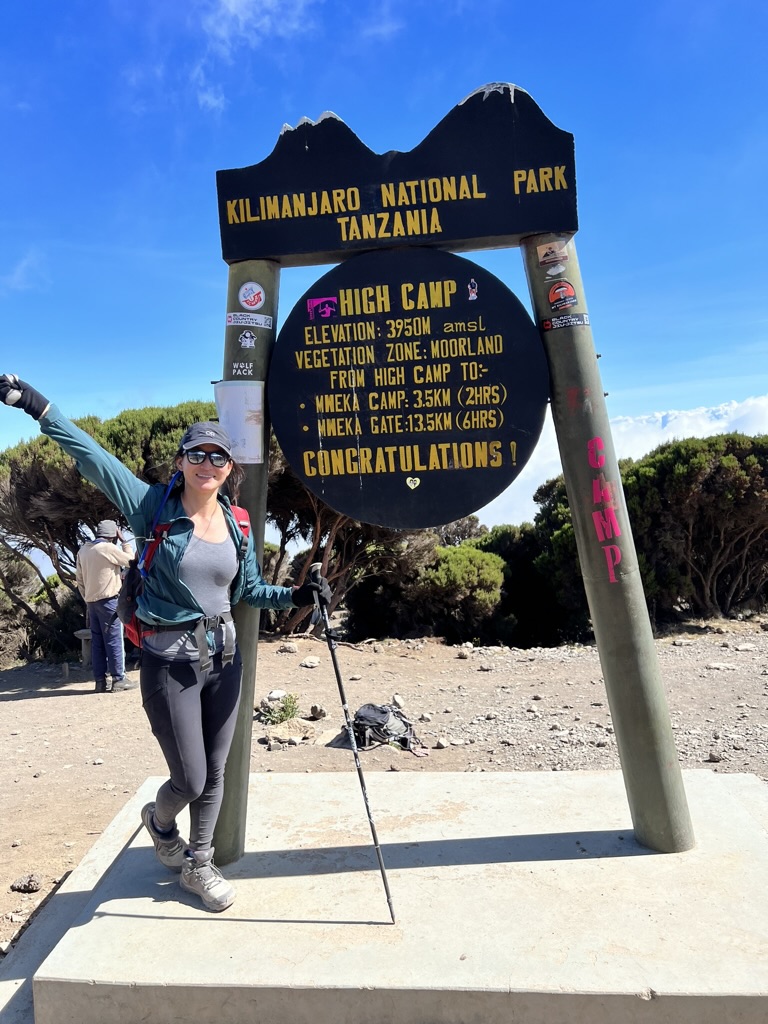
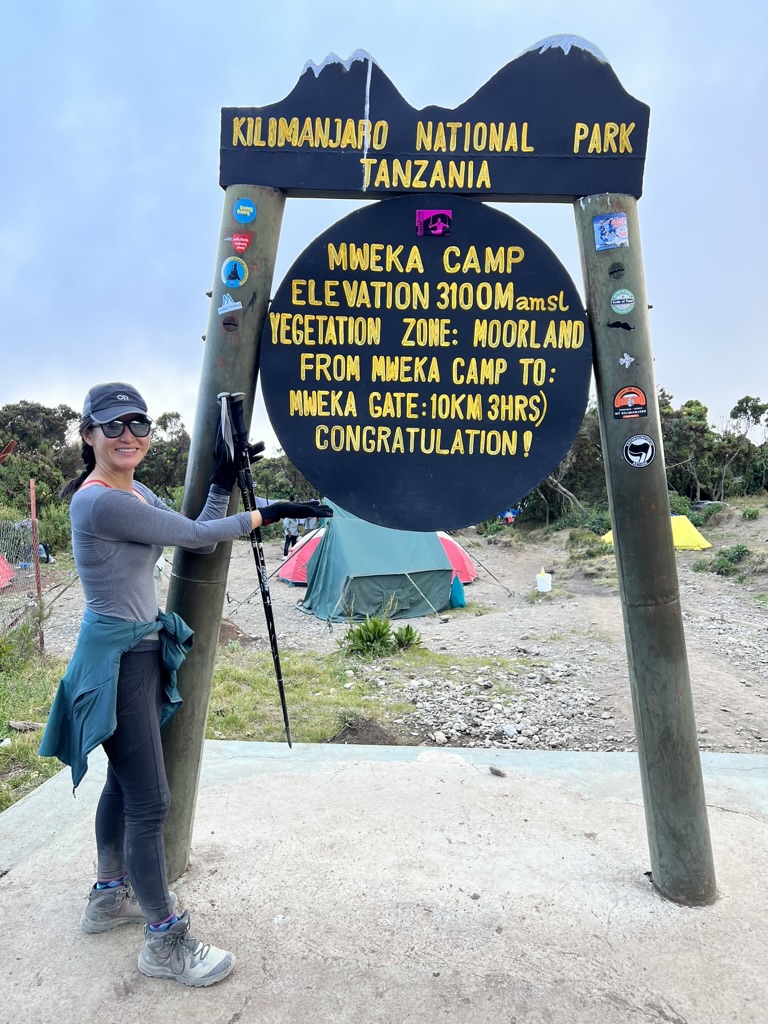
Approaching camp, I started chatting with my porter Mohammed. He shared he was from Arusha and asked where I was from. When I said “The U.S.”, he exclaimed “I love America!”, and raised his sleeve to reveal a bracelet with the American flag on it. Mohammed shared that he loves hip hop and rap, and that he was a rapper himself. He was working to save up to go to school to study English further (though his English was already quite good, I must say!) so that he could eventually become a trek guide. I loved hearing his story. What a cool dude.
That night – our final night in the mountains – I’ve never slept better. Who woulda thunk – at a cool 3,100m (10K feet) elevation?
Day 7 Destination: Out of the woods
Our final descent of the Kilimanjaro trek was just one big ol’ Jungle slip-n-slide. I stumbled an infinite number of times, but credit to my hiking poles because my ass only hit mud once. Got bit by 2 mosquitos (great), and saw some more Colobus monkeys, one which tried to defecate on us from high up in the trees (but missed by a few feet).
And after a few hours – finally, finally, FINALLY, made it to the Mweka park gate.


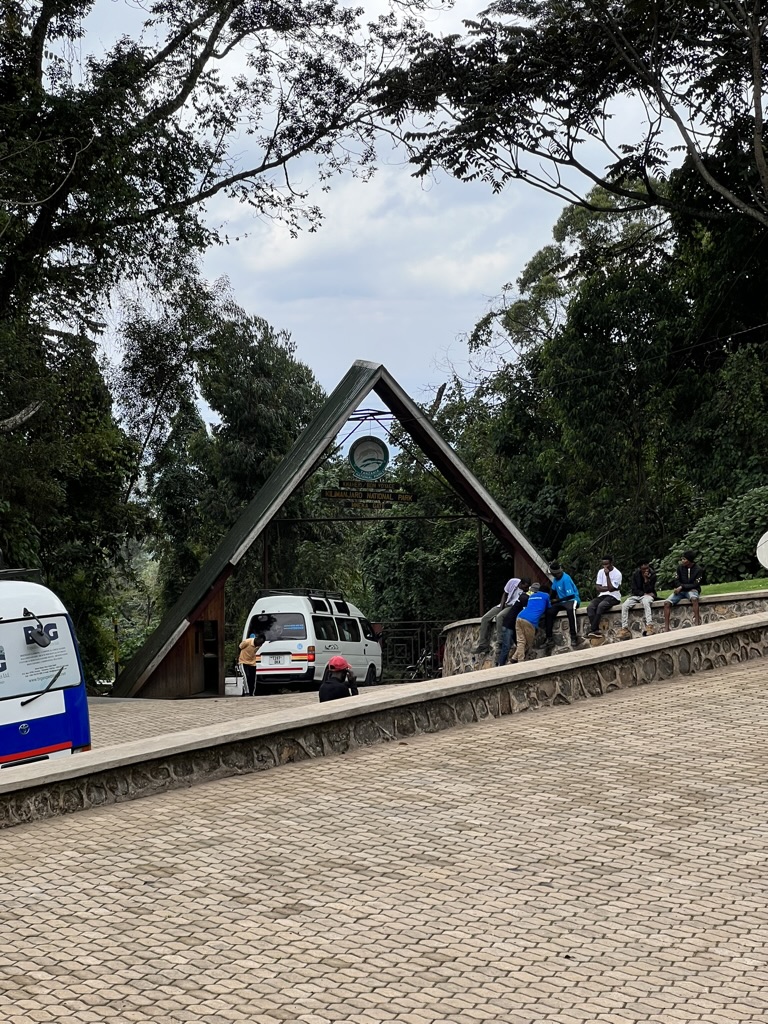
It was actually an out-of-body experience re-introducing back to “civilization” after 7 days. Saw a Land Cruiser and thought “wow, cars, what a weird concept.” At the gate visitor center, I squealed and marveled at the running water and flushing toilets. AND A MIRROR – THERE WAS A MIRROR – what a novel invention. On the mirror, clear as day, I could see the last seven days’ gunk caked on my face.
We were zipped away by bus (again, packed to the brim, this time with 30 RIPE-SMELLING humans) to an arts center, where we would have our final team lunch. Lunch was so cute – our “waiters” from the trek continued to wear their chef outfits and serve us, and the entire crew of guides and porters crowded around us and sang the same song from the start of the trek, Jambo Bwana. This time, the dance circle segment was void of awkwardness – after all, we were well acquainted.
Mohammed approached me after lunch. “I wanted to give you this.” He handed me a bracelet that said “Hakuna Matata” (For the 0.05% who haven’t seen Lion King, it means “no problems” or “no worries”).
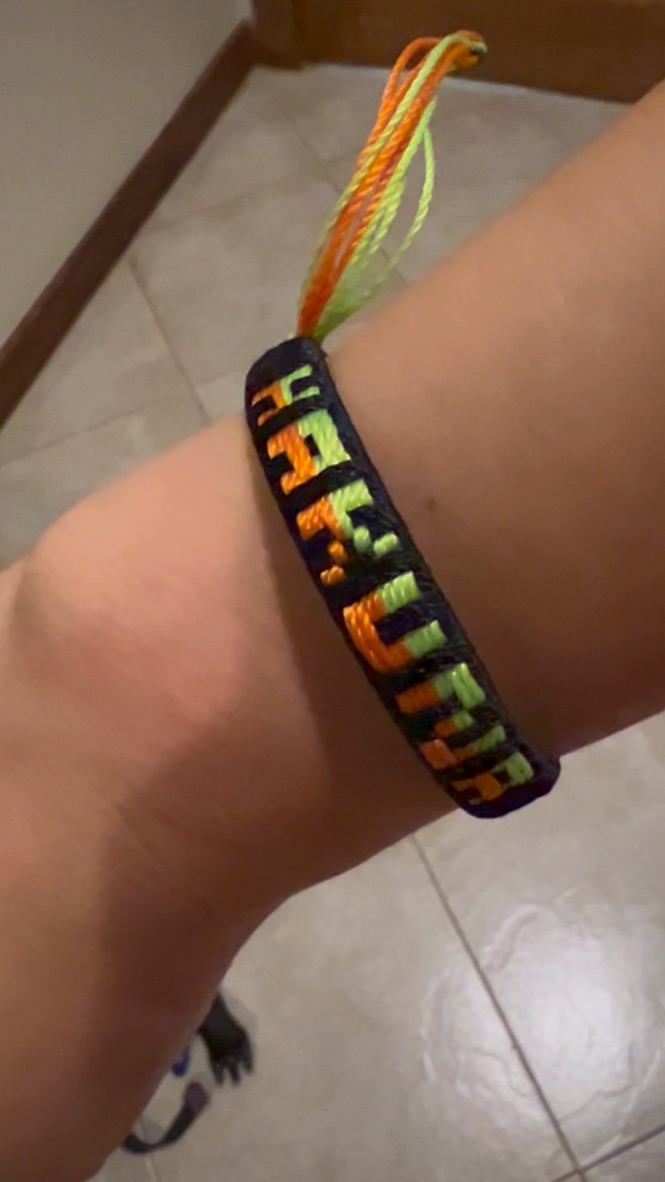
I was so touched. I wish him well and know he’s going to become an amazing guide one day.
Finally, one of the trekkers Yvette gave an incredibly moving “thank you” speech to the whole crew that supported us.
By that point, I was crying real tears.
The next morning, at breakfast in the hotel near the airport, one of my trek mates asked me: “Do people actually stay in touch after these types of things are over?”
I told him: “Well, when I did the Inca trail, we stayed in touch for a little while through text. But not for too long after. And now, not at all.
“That said, I think there’s a beauty that we are all lines that converge and intersect for a brief moment, experience something so wondrous together… then go our separate ways. In some ways, I think it makes these moments, these experiences, ever the more precious.”
There is beauty in the divergence.
On October 5th, my grandfather’s path and mine diverged.
I won’t lie and say that my grandfather lived a happy and fulfilled life up to his last day. He did not.
He had lost the will to live for the last decade or so, and even more so after the death of his wife, my grandmother, in 2018. He was constantly worrying about money and finances, and the few things that made him happy were the successes (mostly financially) of his kin. He worried of money: how much we made, how much we spent. Obsessed with it. But it’s because he lived a life not thinking he ever had enough – and wanted us, those he loved, to never, ever feel that way.
There was a waiting game after my grandfather passed away when I didn’t know if I would go on this trek. I found out four days before my flight for Africa that his cremation was scheduled in Taiwan for two days after I would finish Kilimanjaro. I took it as a sign. A sign from him that despite the immense strife of his last years, he was selflessly gifting me wealth – he was gifting me life. Telling me, despite my own trepidation of the future and of the years to come, that I have so much life to live, so many experiences left to share.
That type of wealth is intangible – and yet, I believe, more valuable.
Thank you so much, Ah Gong. You no longer have to worry about us. Rest easy and say hi to Ah Ma for us. I love you.
Mendi
 the wanderlust is real.